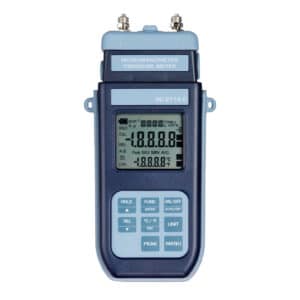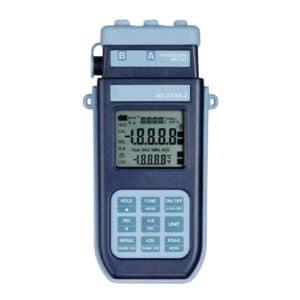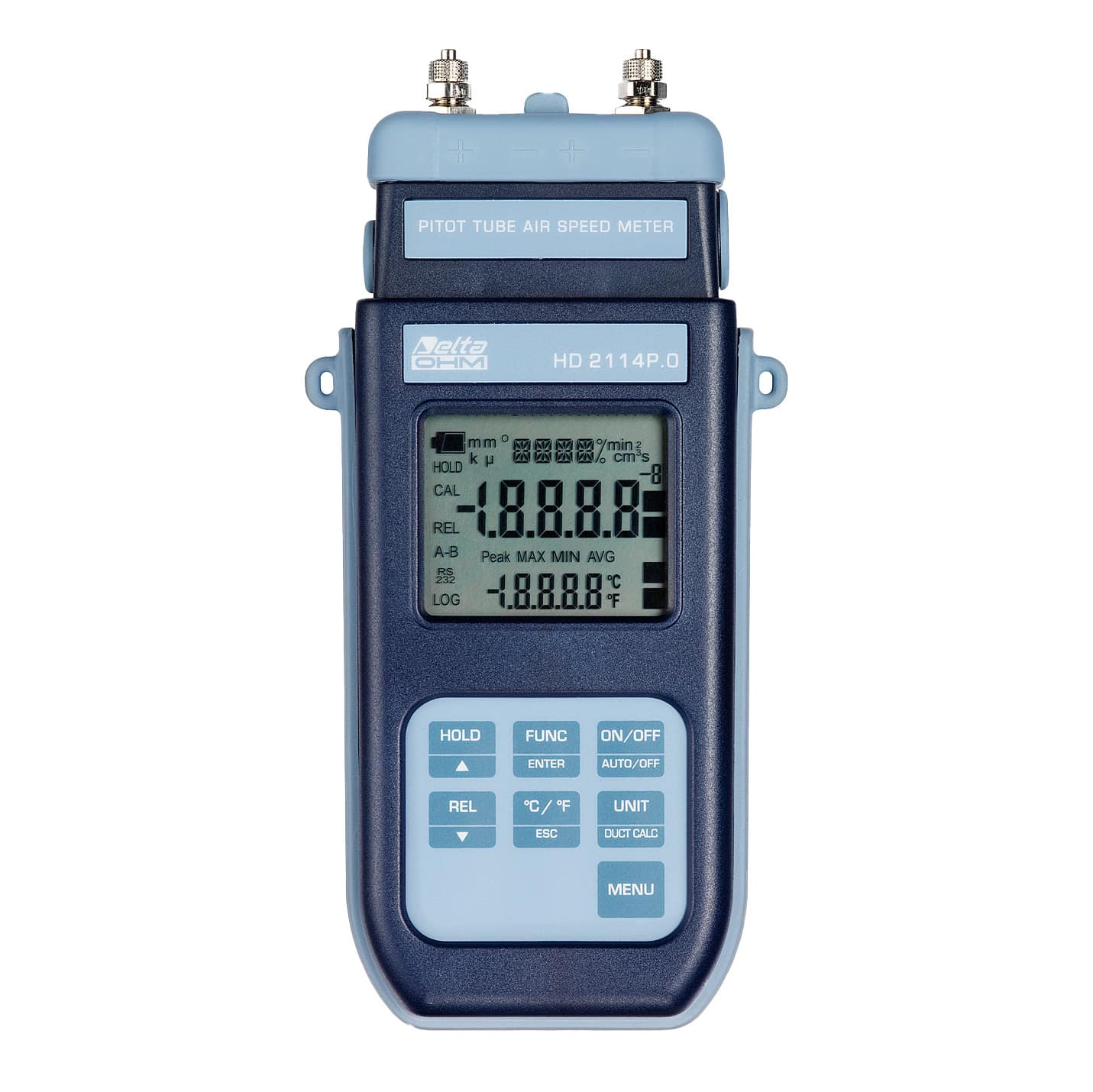
The micromanometer-thermometer for air velocity measurement is a portable instrument designed for applications in air conditioning, HVAC, heating and ventilation systems, where air velocity and airflow rate must be measured using a Pitot tube. The instrument measures the differential pressure generated by the Pitot tube and calculates from this value both air velocity and airflow rate in ducts, air channels and diffusers.
The version with 20 mbar full scale is intended for velocity measurements from 2…55 m/s, making it suitable for HVAC and ventilation applications where medium-low air velocities are involved or where high sensitivity to small pressure differences is required.
In addition to pressure and velocity measurements, the instrument also measures temperature with K thermocouple probes in the range -200…+600 °C. It can therefore also be used as a portable thermometer by connecting K thermocouple probes with standard miniature connector. In Pitot tube measurements, the air temperature can be included in the calculation, with automatic or manual compensation within the specified range.
Airflow rate is calculated by entering the duct cross-sectional area, with a configurable range from 0.0001…1.9999 m². This allows the instrument to go beyond simple air velocity measurement and evaluate volumetric airflow, useful for ventilation system checks and air balancing operations.
The Max, Min and Avg functions allow maximum, minimum and average values to be displayed during measurement. The instrument also includes REL relative measurement, HOLD function and selectable auto power-off. The IP66 protection rating makes it suitable for field use, including technical environments and maintenance operations.
Compared to the datalogger version, this model is more suitable when direct and immediate measurements are required, without the need to internally store long data sequences or transfer them later to a PC.
Applications
- Air velocity measurement in ducts, air channels and diffusers
- Airflow calculation in HVAC, air conditioning and ventilation systems
- Checks on heating, air conditioning and air treatment systems
- Measurements with Pitot tubes on non-corrosive gases and dry air
- Differential pressure verification with 20 mbar full scale
- Temperature measurements with K thermocouple probes
- Rapid field checks during maintenance, commissioning and system balancing
- Use with AISI 316 stainless steel Pitot tubes selected according to the duct application
FAQ – Micromanometer-thermometer
When should the 20 mbar full-scale micromanometer be selected?
It is suitable for measuring air velocities from 2 to 55 m/s, typical of many HVAC, ventilation and duct inspection applications. Compared to the 200 mbar version, it is more suitable for lower air velocities and smaller differential pressures.
How is air velocity calculated?
The instrument measures the differential pressure generated by the Pitot tube connected to the pressure inputs. From this value it calculates air velocity, taking into account the instrument settings and air temperature.
Can it also calculate airflow rate?
Yes, by entering the duct cross-sectional area the instrument can calculate airflow rate. The configurable section range is from 0.0001 to 1.9999 m².
What is the difference compared to the 200 mbar model?
The 20 mbar model works with air velocities from 2 to 55 m/s, while the 200 mbar version reaches up to 180 m/s. The choice therefore depends on the air velocity to be measured and the expected differential pressure range.
Does the instrument also measure temperature?
Yes, it measures temperature using K thermocouple probes in the range -200…+600 °C. It can also be used as a portable thermometer with compatible probes fitted with standard miniature connector.
Are Pitot tubes included in the supply?
No, Pitot tubes, PW cable and K thermocouple probes must be selected and ordered separately. This allows the instrument to be configured according to tube length, duct type and application requirements.
Which fluids can it be used with?
It is designed for gases and non-corrosive dry air compatible with the sensor membrane. Compatibility should always be verified according to the application and operating conditions.
Fill out the form below to contact us.
"*" indicates required fields