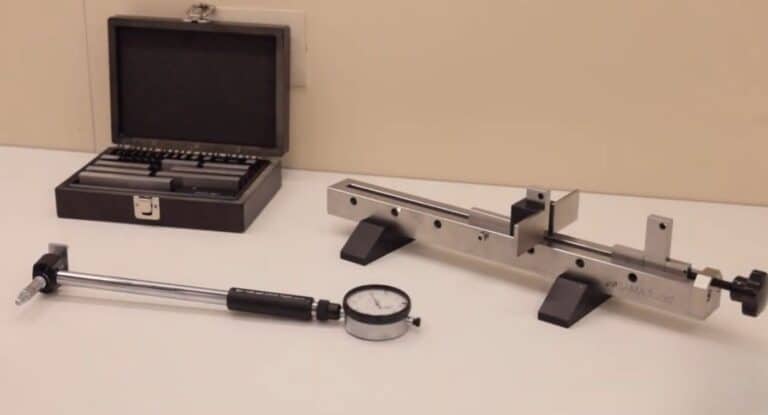
Have you ever seen a batch rejected even though all measurements were within tolerance?
This is not uncommon, and it is very often linked to a single underlying issue: the choice of measuring instrument.
In many cases, the problem is not related to calibration or operator skill, but to how dimensional inspection is carried out. The instrument is often chosen out of habit or convenience, simply because it is available on the workbench, which can lead to overlooking a core principle of industrial metrology: the measurement is not defined by the instrument, but by the tolerance. When decisions are made by the tools that are available instead of the specifications on the technical drawing, the risk of non-conformity is introduced from the very start.
A Common Mistake: Using the Caliper for Everything
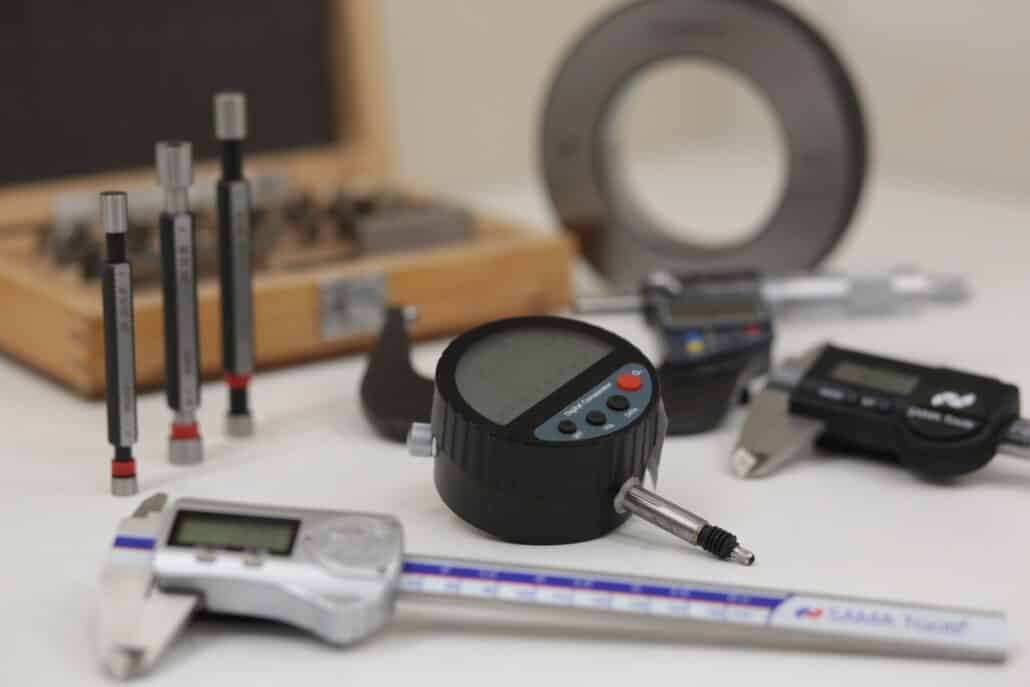
The Vernier caliper is the “Swiss army knife” of the workshop. It’s fast, versatile, and generally reliable. However, convenience is the worst enemy of accuracy. Using a digital caliper (even a high-quality one) to verify a tolerance of ±0.02 mm is a technical suicide.
The instrument’s inherent uncertainty, combined with parallax error (if analog) or variations in operator contact pressure, makes the measurement not statistically significant. With tight tolerances, the caliper can take up more than 50% of the tolerance due to its own measurement uncertainty. The result? You may end up rejecting parts that are actually compliant or, even worse, accept parts that fall outside specification because the instrument effectively “rounds off” the measurement in your favor.
If you use a caliper on tight tolerances:
- up to 50% of the usable tolerance is lost
- the likelihood of false acceptances increases
- operator-related variability is introduced
We have repeatedly seen parts being accepted in the workshop and then rejected later in the process, simply because the measuring instrument was not suitable for the specified tolerance.
Choosing the Right Measuring Tools for Each Tolerance
The selection of measuring instruments should never be based on what is simply available, but on the tolerance specified in the drawing.
It is the tolerance that defines the required level of precision and therefore determines the correct instrument to be used.
If you are considering using a caliper for these applications, you can find a complete guide here on how to choose the right one based on the application, with practical examples and real cases.
The 10:1 Rule (explained with a real-life example)
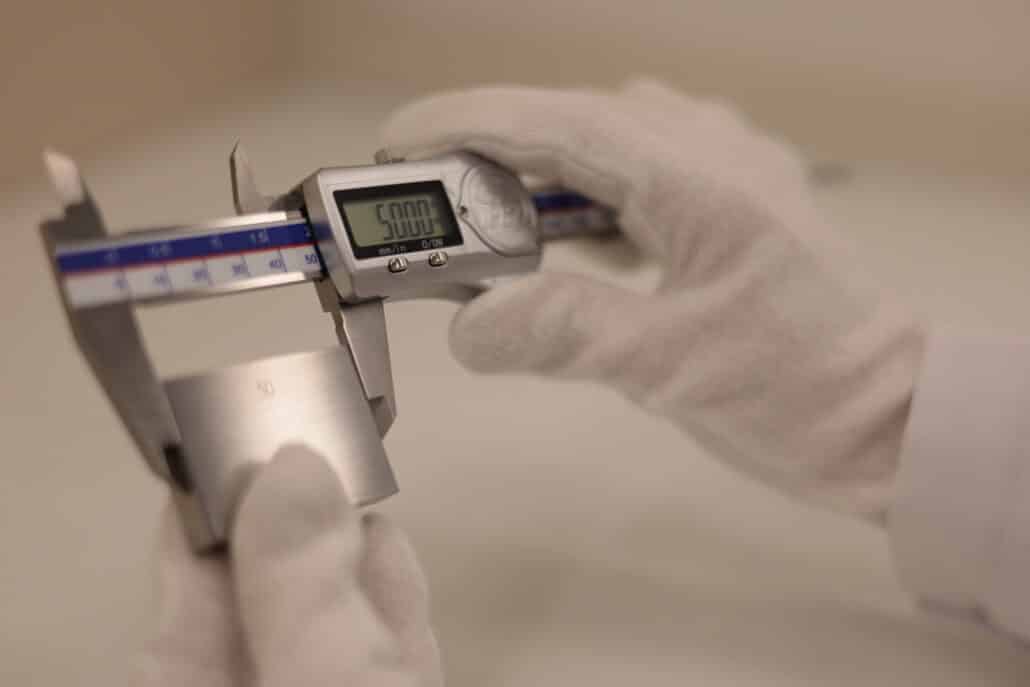
To correctly select measuring instruments and their associated tolerances, academic theory refers to complex ratios, but in industrial practice a widely used guideline is the 10:1 rule.
In practice, this means the instrument’s resolution and ideally its measurement uncertainty, should be at least one tenth of the total tolerance being verified.
- Practical example: You need to inspect a shaft with tolerance 50 h7 (with a deviation of 0 / -0.025 mm).
- Your total tolerance range is 25 µm (microns).
- According to the 10:1 rule, you need an instrument capable of resolving measurements at the micrometer level (2.5 µm).
If you use an instrument with a 0.01 mm resolution, you are already consuming 40% of your tolerance band through reading uncertainty alone. If this ratio is not respected: you aren’t measuring, you’re guessing.
When to Use a Micrometer or Dial Gauge
Once the tolerance is defined, the choice of instrument is no longer optional.
It is not a matter of preference, but of geometry and contact force. Ultimately, it is about avoiding systematic measurement errors.
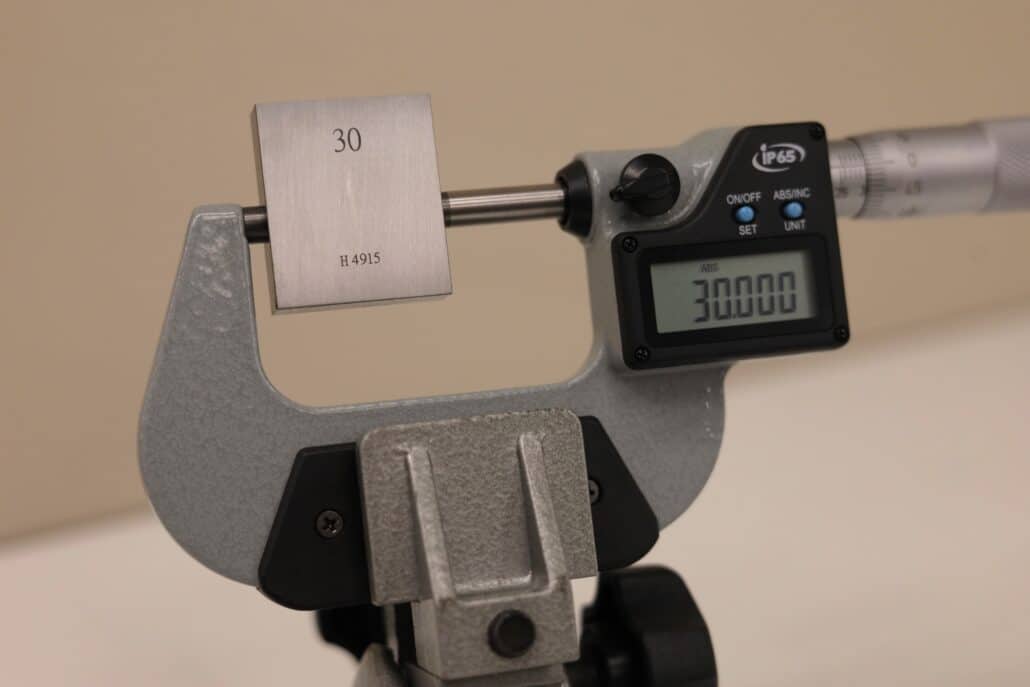
- If you need to measure outside diameters or thicknesses with tolerances below 0.05 mm, the right solution is a centesimal or thousandth-resolution micrometer. Its friction mechanism guarantees a consistent contact force that a caliper cannot reproduce, eliminating the human error linked to the technician’s “hand”.
- If you need to assess form errors or dimensional deviations, a centesimal dial gauge mounted on a magnetic base or dedicated stand is the appropriate choice. A caliper measures the distance between two points, whereas a dial indicator measures variation relative to a fixed reference.
-
If you need to measure holes with high accuracy: a dial bore gauge is the appropriate tool, which allows you to detect ovality and taper that a simple caliper would never be able to identify.
Real Case Study
During some audits, it became clear that the issue was not the machining process, but the measurement chain: instruments that were correct on paper, but not consistent with the tolerances that actually needed to be verified.
In a company that manufactures hydraulic components, valve bodies were being rejected by the end customer due to dimensional interference, despite internal inspection reports indicating conformity.
The investigation revealed that the final inspection was being carried out using digital calipers on H7 tolerance holes.
The mistake was invisible: the caliper would enter the hole with minimal clearance or be imperceptibly tilted, producing readings that appeared acceptable. By replacing the process with a system using bore gauges and inside micrometers, the rejection rate dropped from 12% to 0.5%.
The production process itself was sound; it was the lens through which it was being evaluated that was blurred.
Ultimately, the problem was not the process but the instrument used to validate it.
Conclusion
Using the wrong instrument does not simply lead to poor measurement—it leads to incorrect decisions based on data that only appears reliable. An experienced technician understands that accuracy is not achieved by selecting the most expensive instrument, but by choosing the one that ensures the correct balance between measurement uncertainty and design tolerance.
Have you verified whether your instruments are actually aligned with the tolerances you work with every day?
Optimize your quality control with SAMA Tools
If you are checking critical tolerances with unsuitable instruments, the risk is not theoretical. It’s already embedded in your process.
If you want to verify whether your measurement chain is truly reliable, let’s talk about it together.
👉 Contact us today for a technical consultation or a personalized quote