Dimensional measuring instruments are at the core of modern industrial metrology. For quality control technicians, ISO system managers, and laboratory metrologists, using them correctly means making sure that what is produced truly matches the design. This allows for technical decisions that are consistent, reliable, and repeatable.
Dimensional measurement is the first line of defense against defects and nonconformities: without accurate and reliable dimensional data, a production process cannot be considered truly controlled. For this reason, dimensional inspection instruments are essential for ensuring the traceability required by ISO 9001.
Role and Importance in Industrial Metrology
Within the production and inspection chain, dimensional inspection instruments make it possible to verify that physical quantities—such as lengths, diameters, thicknesses, and geometric tolerances—comply with design specifications. Industrial metrology focuses on the relationship between the measurement result and the functional requirement of the component, in accordance with the criteria defined by ISO standards like ISO 1101.
In regulated sectors—such as automotive, aerospace, and medical devices—the ability to demonstrate consistent and verifiable measurements is a mandatory requirement. Dimensional inspection is therefore not an isolated activity, but a structural element of the quality management system.
A Classification of the Main Dimensional Measuring Instruments
Dimensional measuring instruments differ in terms of measurement principle, application range, and level of accuracy. Each category addresses specific needs within the production process.
Manual Instruments
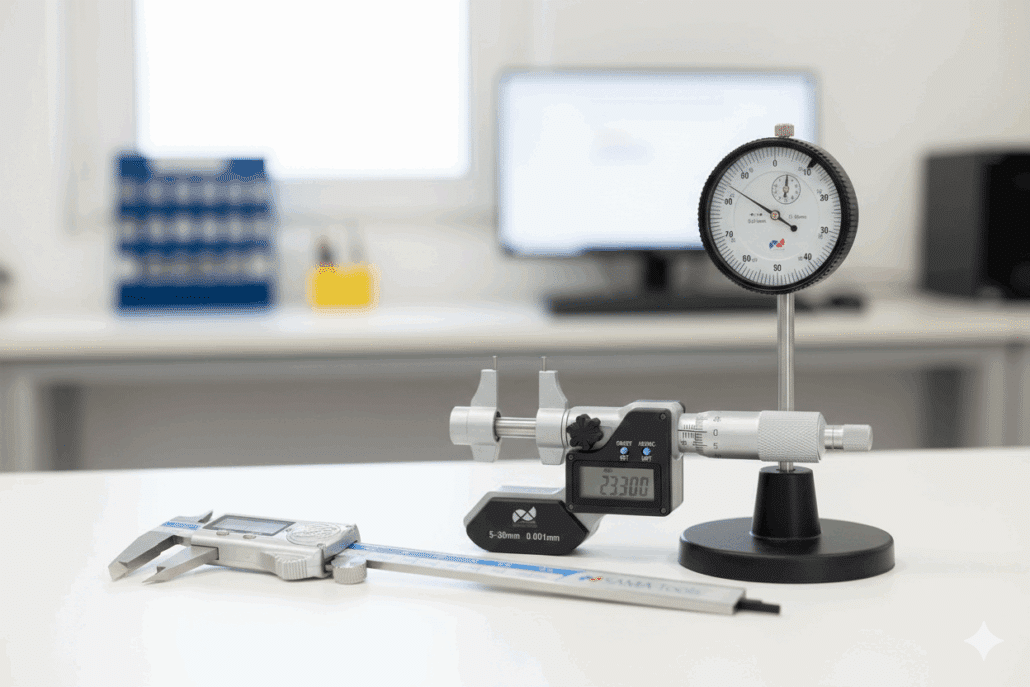
Calipers, micrometers, and height gauges are used for direct contact measurements. They are suitable for quick controls, dimensional verification on finished parts, and intermediate inspections during production.
Comparative and Reference Tools
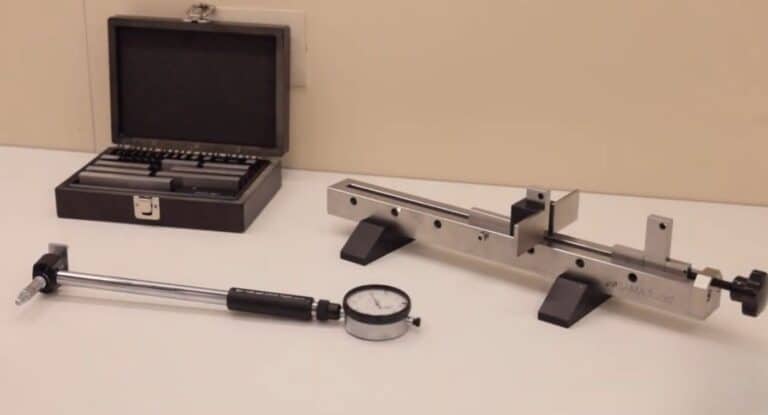
Both dial and bore gauges evaluate deviations, repeatability, and conformity against known dimensional references. The choice of instrument must always align with the tolerances that need to be checked, the operating environment, and the function of the component. High resolution alone does not guarantee that an instrument is suitable for a given application.

Metrological Management and Periodic Calibration
Every instrument used for dimensional inspection must undergo periodic calibration to ensure measurement traceability to International System of Units (SI) reference standards. Calibration intervals are not fixed; they depend on technical factors such as:
- instrument stability
- frequency of use
- environmental conditions
- importance of the production process
Improper calibration management compromises the reliability of the entire quality system. Dimensional inspections should be viewed as a continuous cycle of verification, maintenance, and evaluation of the instrument’s suitability for its intended use.
How to Choose the Right Digital Caliper
The digital caliper is one of the most frequently used instruments in industrial dimensional inspection, valued for its versatility and operating speed. However, the choice must be based on specific technical requirements.
Digital calipers designed for industrial dimensional measurement offer different levels of accuracy, measuring ranges, construction materials, and data acquisition functions.
https://www.samatools.it/strumenti-di-misura/calibri-digitali/
The digital caliper is well suited for measuring moderate tolerances and performing quick dimensional checks, but it may not be ideal for applications requiring extremely tight tolerances or very strict uncertainty limits.
Micrometers and Dimensional Measurement
When tolerances become more restrictive, the micrometer is often the most appropriate instrument. Thanks to a higher resolution, greater accuracy, and a more controlled measuring geometry, it gives more accurate dimensional measurements than a caliper.
Micrometers used in dimensional inspections are used for external, internal, and depth measurements. This is especially true when strict dimensional requirements or critical surfaces are involved.
https://www.samatools.it/search/micrometro/
Choosing between a caliper and a micrometer is therefore less about “stated accuracy” and more about ensuring alignment between the instrument, the required tolerance, and the measurement method.
Dial and Bore Gauges: Comparative Inspection and Deviation Control
Dial and bore gauges are essential for comparative inspections. They don’t give absolute measurements, but they make it possible to check deviations from a reference, helping to monitor the repeatability and stability of the process.
Dial gauges for dimensional inspection are used both in laboratories and on the production floor for rapid checks, machine setup, and verification of dimensional conformity across batches of parts.
https://www.samatools.it/search/comparatore
Dial and bore gauges are particularly effective when it is necessary to monitor small variations and dimensional trends over time.
A Complete System of Instruments
Effective dimensional control doesn’t depend on a single instrument, but on an integrated set of technical tools. Calipers, micrometers, dial gauges, bore gauges, height gauges, gauge blocks, and other mechanical devices all work together to create a reliable measurement system.
Proper selection and integration of dimensional inspection instruments allow the verification method to be tailored to the actual requirements of the production process.
https://www.samatools.it/strumenti-di-misura/
Operational Best Practices for Maintaining Reliability
Reliable and repeatable results in dimensional inspection depend on a number of essential practices:
- monitoring and controlling environmental conditions
- ensuring technical training for operators
- maintaining traceable and documented calibrations
- performing regular verification of instruments
- systematic and organized recording of results
When these practices are consistently applied, the performance of dimensional inspection directly reflects the maturity of the quality system and the stability of production processes.
Technical and Operational Summary
Dimensional inspection instruments are essential for ensuring industrial quality. Their careful selection, management, and use are more than just regulatory obligations—they are effective tools for reducing nonconformities, rework, and errors in decision-making.
A measurement is only truly useful if it helps make reliable and consistent decisions. In this sense, dimensional inspection is not secondary, but a fundamental technical skill for any organization that is committed to quality.