Consider this: a pipe, tank, or metal structure is already installed, and only the external surface is accessible.
How can the material thickness be measured when access is limited to one side only?
Ultrasonic thickness measurement provides a solution by determining the material thickness without cutting the component or requiring access to the opposite surface.
One of the instruments used by Progetto PSC for this type of inspection is the SAUT310D-SW SAMA Tools ultrasonic thickness gauge.
Progetto PSC and Non-Destructive Testing
Progetto PSC operates in the field of non-destructive testing, on-site inspections, and technical training.
For these activities, it uses a range of inspection technologies, including ultrasonic testing.
The SAUT310D-SW thickness gauge measures the thickness of metal materials even when the surface is covered with paint or an insulating coating.

How to measure thickness from one side only?
The thickness gauge sends an ultrasonic pulse into the material and measures the time it takes for the signal to reach the opposite surface and return to the probe.
This makes it possible to measure thickness without cutting the component and without needing access to the internal wall.
For example, ultrasonic thickness measurement is done on pipes, tanks, vessels, bulkheads, and metal structures that are subject to wear or corrosion.
Why should you use a through coating thickness gauge?
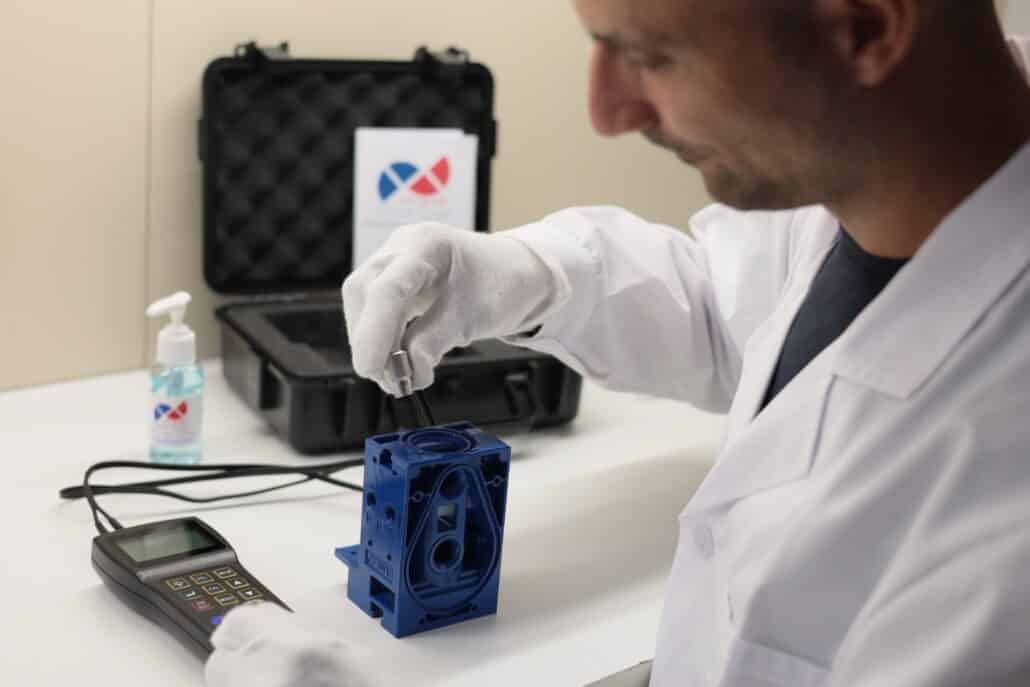
When a surface is coated with paint, an unsuitable thickness gauge may produce measurements that include the coating layer.
The SAUT310D-SW ultrasonic through coating thickness gauge is designed to measure the thickness of the underlying metal while automatically excluding the paint or insulating coating from the reading.
Where measurement conditions allow it, there is therefore no need to remove the paint and restore it after inspection.
This provides a practical advantage when the component is already installed, painted, or in service.
The measurement starts with the ultrasonic pulse that is emitted by the probe and ends when the returning echo is detected, after reverberating through the material and reflecting from the back wall.


The Instrument Provides a Reading. The Method Determines Its Meaning.
Before taking a measurement, it is essential to identify the material and set the correct ultrasonic sound velocity.
A coupling gel must be applied between the probe and the surface to allow ultrasonic waves to pass through the material.
Accurate measurements also depend on several factors, including:
- surface condition;
- component geometry;
- expected material thickness;
- type of coating or covering;
- probe selection.
When assessing material thinning or loss caused by wear or corrosion, measurements should be taken at multiple points.
A single reading only reflects the condition of the specific point measured. It does not automatically represent the condition of the entire component.
Which ultrasonic thickness gauge should you choose?
Selecting the right thickness gauge involves more than simply considering the specified measurement range.
The choice of instrument and probe depends on several factors, including the material, component geometry, thickness, surface condition, and the presence of coatings.
Explore the range of SAMA Tools ultrasonic thickness gauges, or share details about your component and inspection requirements.
Our technical team can help identify the most suitable configuration for your specific application.