

Have you ever released a batch of bores, only to have the customer reject them after their inspection indicates they are out of tolerance? Sometimes the difference is just 5 or 6 microns but that’s enough to trigger a claim that becomes difficult to handle. Meanwhile, your dial bore gauge is calibrated, the certificate is on file, and the instrument has never been dropped or mishandled.
In most cases, the problem is not the instrument itself, but the method. More often than not, the critical factor is how the dial bore gauge was zeroed shortly before the inspection began.
In this article, we take a closer look at what really happens at the inspection bench when theory meets practice, starting from the operating sequence shown in our technical video. Because metrology isn’t just about numbers on paper, it’s also about operator sensitivity, consistency, and correct procedural discipline.
The Calibration Certificate Myth: Why It Doesn’t Guarantee Measurement Accuracy
Let’s stop thinking of a calibration certificate as a shield against errors. Calibration is a snapshot: confirmation that, at a specific moment and under controlled laboratory conditions, the instrument was performing within specification.
Once the dial bore gauge is used on the shop floor, you become the variable. A bore gauge is a comparative instrument: it doesn’t determine the measurement—it simply tells you how far you are from the zero you’ve set. If that initial reference is “off” or approximate, you’re essentially measuring a systematic error very precisely.
Have you ever asked yourself whether your zeroing process is repeatable, or if it changes every time you reassemble the gauge block stack?
Correct Zeroing Procedure: See Our Technical Video
In the video, we walk through a sequence that might seem routine, until you end up with two different measurements on the same part. Here are the key steps for a zeroing procedure that can withstand even the most demanding inspection:
- Sample Preparation: We use certified gauge blocks with the same nominal dimension as the target measurement.
- Creating the Base (many skip this step): We place the gauge blocks into a stainless-steel packer or holder. This becomes the “zeroing base”: without a packer that keeps the blocks perfectly aligned and under constant pressure, the reference is unstable.
- Assembly and Calibration: We mount the dial indicator onto the bore gauge and position the measuring head between the gauge blocks.
- Identifying the Reversal Point: We rotate the bezel until zero aligns with the needle at the reversal point. It’s not enough to simply reach zero, you need to make sure it corresponds to the minimum distance between the block faces.
Only at this point is the instrument properly zeroed against primary standards, allowing you to measure the bore with full accuracy.
Have you ever wondered whether your dial bore gauge is truly zeroed correctly?
In this video, you can see exactly how it’s done: from sample preparation to identifying the reversal point. A method designed to eliminate subjective variables and ensure repeatable measurement.
The Invisible Enemy: Thermal Drift in the Workshop
One factor that is often underestimated is temperature. This includes the heat transferred to gauge blocks while handling them during stack assembly, or workpieces that have just come off the machine and are still warm.
Even a set of gauge blocks warmed by your hands for a couple of minutes can expand enough to lead to a measurement error. If the reference is not allowed to stabilise and you don’t account for the thermal difference between the bore gauge and the part, your measurement is not reliable. It’s merely an assumption.
SAMA Tools Measurement System: Procedure Shown in the Video
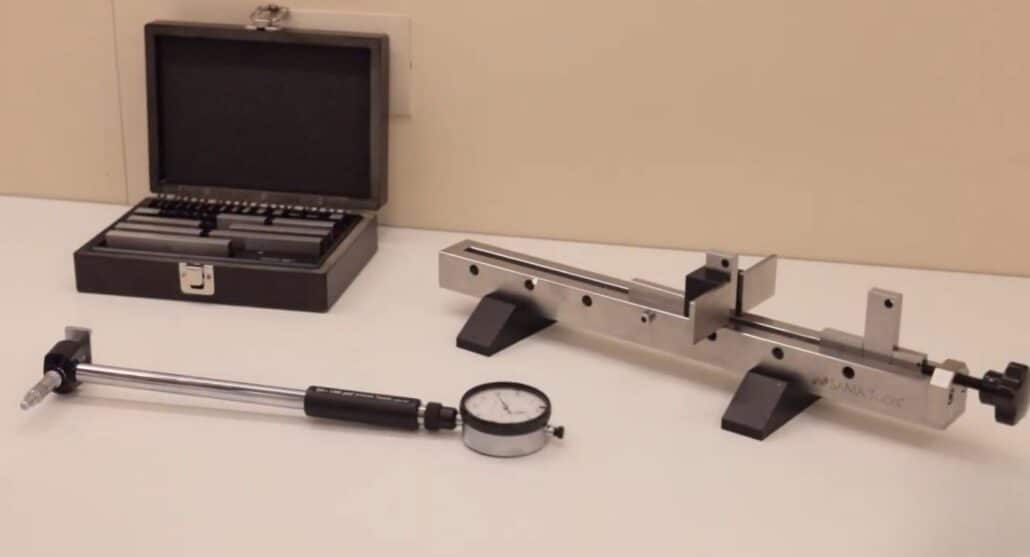
To achieve the results shown in the video, we don’t use random instruments, but an integrated system where each component plays a role in limiting human error:
- SATARBPP Stainless Steel Gauge Block Packer: Essential for eliminating play between gauge blocks and creating a stable and solid reference.
- SA021EZ Analog Dial Gauge: The “readout” device that must deliver reliable and repeatable measurements.
- SAJ47-01 Steel Gauge Block Set: Grade 1 primary standards for traceable measurement certainty.
- SA7103 Dial Bore Gauge: The measuring instrument designed to transmit deviation without deflection or parasitic friction.
FAQ: Frequently Asked Questions About the Dial Bore Gauge
How do you zero a dial bore gauge correctly?
Certified gauge blocks are clamped in a stainless-steel packer, and the dial gauge is set at the needle’s reversal point. Only then does the measurement become reliable.
Why is there a difference between my dial bore gauge measurements and the customer’s?
The most common causes are inaccurate zeroing or thermal drift: heat transferred to the gauge blocks during handling and assembly, or a workpiece that is still warm, can introduce subtle but systematic errors that are not immediately visible.
What’s the difference between calibration and zeroing a dial bore gauge?
Calibration certifies the instrument in a laboratory. Zeroing, instead, is the operational step carried out by the operator before each measurement, and it is exactly at this stage that most errors can hide.
Conclusion: The Right Measurement Is a Choice, Not a Matter of Chance
When a customer disputes a bore measurement, your only real defense is being able to demonstrate an irrefutable method. It is not enough to say “the instrument is accurate.” You need to be able to say: “We zeroed using certified gauge blocks, secured them in a packer, identified the reversal point, and verified thermal stability.”
If you feel there is still too much subjectivity in your inspection process, or if measurements taken on the shop floor never align with those from the metrology lab, it may be time to stop changing instruments and start changing your method. Do you have a critical issue in your workshop? Let’s examine it from a technical standpoint together. We can analyze your current measurement procedure and identify where the systematic error is hiding. Contact us to speak to one of our technical specialists.

