This guide examines how the height gauge fits into an industrial dimensional control system, making sure that every measurement is referenced against a stable and reliable standard.
What is a height gauge and what is it used for in dimensional inspection?
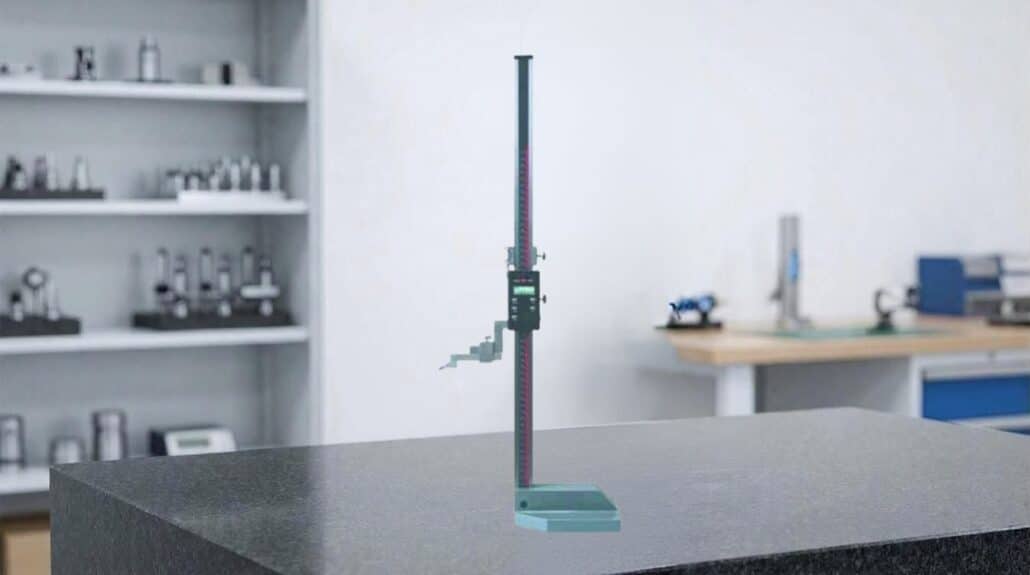
A height gauge is a mechanical tool designed to check or transfer height measurements in relation to a known reference surface, usually a granite surface plate. The term “height gauge” refers to this classic measuring instrument, which is still widely used in both workshops and metrology labs for controlling dimensional heights.
For a complete selection of height gauges suitable for workshops and quality laboratories, please see our complete range here.
The Importance of Height Verification in the Workshop
You need to drill a steel plate, but the tolerance is tight. Even a small misalignment—just a few tenths of a millimeter—can cause the hole to miss its mark, forcing you to rework the bracket or, in the worst case, scrap it entirely. This issue is more common than most realize, and it often starts right at the marking stage. That’s where the height gauge proves its value: it allows you to accurately and consistently transfer dimensions from the drawing to the part on the surface plate.
In any dimensional control process, every measurement must be referenced accurately. When a dimension is specified as a height from a machined base, the method of measurement is crucial. Using a height gauge on a surface plate ensures the nominal dimensions are correctly related to the component’s function, minimizing the risk of nonconformities.

Using a Height Gauge on a Surface Plate
In industrial dimensional control, a height gauge is used to measure or transfer height dimensions based on a reference point.
The height gauge is always used with a surface plate, which is usually made of granite and which provides a stable and perfectly flat reference. Placing the workpiece on the plate allows the gauge—set to the desired height or used with a dial gauge—to mark or check dimensions accurately.
To get precise measurements, move the micrometric adjustment and the contact (or scribing) tip smoothly, without vibrations. Take readings from the vernier scale or digital display. It’s also important to keep the surface plate clean and the workpiece stable during the process.
Operating Procedure Summary
When using a height gauge for dimensional control on a surface plate:
- Make sure the surface plate is clean and the workpiece is free of burrs.
- Secure the component in place, aligning the reference base with the technical drawing.
- Set the nominal height using the micrometer adjustment or a reference standard.
- Carry out the measurement or marking with smooth, controlled movements, avoiding excessive pressure.
- Check the result against the specified tolerance and verify that the part meets its functional requirements.
It’s the method that ensures repeatability—not just the instrument’s resolution.
Three Situations Where a Height Gauge Can Come to the Rescue
Marking Before Drilling
When drilling a steel plate, a precise reference line is essential. When using a height gauge, you can set the dimension from the surface plate and mark directly on the workpiece. Relying on visual alignment or basic bench tools increases the risk of misplacing the hole and compromising the drilling center. The height gauge helps prevent these errors and minimizes the need for rework.
Checking Parallel Surfaces
During dimensional inspections, you examine two machined shoulders. With the part placed on a surface plate, a height gauge equipped with a dial gauge is used to verify that the surfaces are uniform. Comparing the measurements allows you to quickly identify any differences in height or misalignment.
Height Measurement Before Assembly
After machining a part and before assembling two components, you measure the shoulder with a height gauge to confirm it meets the required tolerances. Skipping this step can lead to interference or excessive play. Doing so helps achieve smoother assembly and reduces scrap.
Different Height Gauges and How to Choose the Best One
In industrial dimensional control, there are several types of height gauges, each suited to specific operating conditions and tolerance requirements.
Analog Height Gauge
Classic model with a vernier scale. Sturdy and reliable, suitable for quick marking tasks that require simplicity and immediate readability.
When to use it: In the workshop, for individual parts or initial markings where documenting the measurements is not needed.
Digital Height Gauge
Features an electronic display and micrometer adjustment. It provides clear and fast readings, that help minimize measurement errors.
When to use it: For repeated inspections on a series of parts, or whenever dimensional alignment requires consistent, recordable values.
Height Gauge with Dial Gauge Adapter
Equipped with an adapter to use with a dial or digital gauge to detect even the smallest deviations from a specified dimension. Typically used in metrology labs or on inspection plates.
When to use it: Ideal for directly comparing surfaces in precision dimensional control, where every tenth of a millimeter matters.
Digital Height Gauge with Handwheel
Provides smooth and stable height adjustment, minimizing the risk of accidental movement during marking.
When to use it: Ideal for inspection benches where repeatable measurements are required and frequent height changes need to be made without vibrations.

Double-Column Height Gauge
The double-column design increases rigidity and consistency in readings, even on large workpieces.
When to use it: Ideal for measuring bulky components or when strict height tolerances need to be maintained.
Height Gauge with Carbon Rod
Lightweight but stable, designed for tall measurements and settings that require both durability and easy handling.
When to use it: Ideal for measuring heights over 1000 mm, where a steel height gauge would be too heavy to manage.
| Type | When to Use | Ideal For |
|---|---|---|
| Analog | Quick marking and bench use | Traditional mechanical workshops |
| Digital | Repeated checks and fast readings | Quality control in production |
| With a dial gauge | Detecting minimal deviations | Metrology laboratories |
| Double-column | Measuring large components | Medium to large workshops |
| With carbon rod | High dimensions (over 1000 mm) | Tall structures or workpieces |
Dimensional Control with the Height Gauge
A height gauge never works alone. In dimensional control, it is used together with:
- A surface plate, which provides a stable reference
- A dial gauge, for comparative measurements
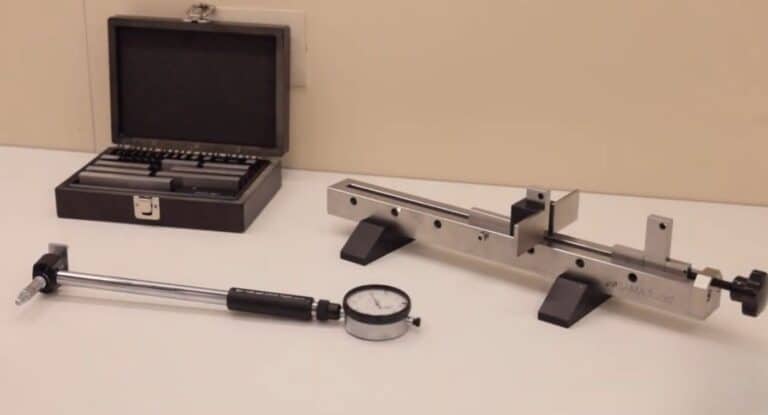
- Gauge blocks, to establish reference dimensions
- Direct measuring tools, such as calipers and micrometers, for additional checks
Only by combining these instruments in a coherent system can dimensional control move beyond simple measurement to become a structured basis for decision-making.
Digital vs. Analog: Key Differences
The difference goes beyond the display. A digital height gauge is especially useful in settings that need:
- Fast and repeatable readings
- Clear, standardized values
- Simple data recording
In certain metrology environments, it can also be connected to data collection systems, though this depends on the specific model and IT setup.
Analog height gauges remain dependable when speed is less critical, offering durability in demanding workshops where dirt, shocks and jolts, and continuous use are factors.
Height Gauges: Typical Mistakes and How to Prevent Them
Excessive pressure: pressing too hard on the tip can damage the part or distort the measurement.
Unsuitable or worn tip: a scratched or dirty tip compromises the accuracy of the reference.
Dirty surface plate: even small burrs or debris can affect the initial measurement.
Incorrect zeroing: failing to properly set the zero point leads to systematic measurement errors.
| Error | Technical Effect | Operational Consequence |
|---|---|---|
| Excessive pressure | Distorts contact between tip and part | Inaccurate measurements that lead to incorrect decisions |
| Worn or dirty tip | Inaccurate reference point | Non-conformities not detected |
| Dirty surface plate | Alters initial reference height | Entire batches out of tolerance |
| Incorrect zero setting | Causes repeated systematic errors | Whole batches become non-conforming |
When Your Instrument Can’t Guarantee Flatness
A height gauge can reveal differences in height relative to a reference on the surface plate, but it is not a substitute for instruments specifically designed to measure flatness.
Checking flatness requires dedicated tools and specialized procedures.

FAQs – Height Gauges and Dimensional Control
Why use a height gauge in dimensional control?
It is used to measure or transfer height dimensions based on a known reference, typically a granite surface plate.
Can a height gauge measure flatness?
No. It can reveal height variations relative to a reference, but measuring flatness directly requires specialized instruments.
When to use a digital height gauge?
They are particularly suitable when fast readings are required, subjective errors must be minimized, and repeated inspections are carried out on a series of parts.
Can a height gauge replace a caliper?
No. Calipers are suited for direct linear measurements, whereas a height gauge is designed to verify heights in relation to a reference base.
Final Tips: Selecting the Ideal Height Gauge for Your Workshop
A height gauge isn’t about achieving perfect metrology, it’s about finding errors before they become a problem.
Here’s a quick guide to choosing the right type:
- Analog: Ideal for marking parts at the bench, working with known measurements, and using a simple, easy-to-handle tool.
- Digital: Best for repetitive checks on series of parts, where fast readability and reducing subjective errors are important.
- Dial guage: Suited for metrology environments where deviations of tenths or hundredths of a millimeter need to be detected.
In modern dimensional control, the height gauge is the dedicated tool for checking heights relative to a known, stable reference. When properly integrated into a measurement system, it detects deviations before they lead to functional non-conformities.
When used correctly, a height gauge is more than a measuring instrument, it acts as a safeguard against process errors and non-conforming parts.
If you’re deciding which height gauge to introduce into your quality department or want to discuss options, you can contact us directly at: 👉 https://www.samatools.it/en/contact/