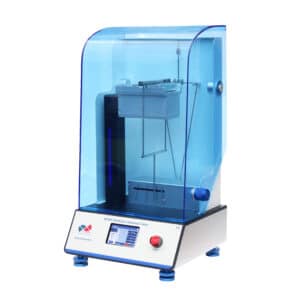
The Buchholz coating hardness tester is used to assess the indentation hardness of dried paints, enamels and coatings. The test makes it possible to verify how effectively the coating resists permanent deformation caused by the controlled application of an indenter to the surface.
The Buchholz indentation test is particularly useful when comparing different coatings or checking the evolution of film hardness after drying or curing. A surface may appear correctly coated while showing different resistance to localised pressure according to the formulation, application cycle or process conditions.
The operating principle of the Buchholz hardness tester involves placing the indenter on the coated sample under the conditions specified by the test method. After the instrument has been removed, the mark left on the surface is observed using an illuminated microscope and measured to determine the test result.
Evaluation is based on the length of the residual indentation: a coating that deforms more leaves a longer mark, whereas a film with greater resistance to indentation produces a shorter mark. The result therefore makes it possible to classify the behaviour of the paint or coating according to the Buchholz method.
The SA510 Buchholz coating hardness tester is suitable for testing flat coated samples that are compatible with correct execution of the test. It can be used in laboratories, quality-control departments and during the development of application cycles, when the indentation resistance of the dried film must be assessed and results from different samples compared.
The Buchholz test is useful for evaluating industrial paints, enamels, protective finishes and coatings that are applied to test panels. The inspection can support comparison between different formulations, drying conditions or treatments that may affect the final hardness of the coating.
The instrument is used for tests in accordance with ISO 2815, the reference standard for determining the Buchholz indentation resistance of paints, varnishes and related products. The method provides an assessment of film behaviour through the observation of the mark produced on the coating.
SA510 includes the indentation system and the elements needed to observe the mark, including an illuminated microscope. This set up makes it possible to carry out the test directly on the sample and provides a practical way to read the resulting trace.
The SA510 Buchholz coating hardness tester is specifically designed to assess the indentation hardness of dried paints and coatings, measuring how the film responds to localized stress in accordance with ISO 2815.
Applications
- Buchholz indentation testing on dried paints and coatings
- Assessment of the indentation hardness of enamels and protective coatings
- Quality-control checks on coated panels and samples
- Comparison between different formulations or application cycles
- Verification of film behaviour after drying or curing
- Laboratory inspection of finishes and protective coatings
- Testing in accordance with ISO 2815
FAQ – Buchholz coating hardness tester
What is a Buchholz hardness tester used for?
It is used to evaluate the indentation hardness of a dried paint or coating by measuring the mark left on the surface after the indenter has been applied according to the test method.
How does a Buchholz indentation test work?
The indenter is applied to the coated surface under the conditions specified by the method. After the test, a residual mark is made and measured using an illuminated microscope to determine the coating’s behaviour under indentation.
What does the mark left on the coating indicate?
The length of the mark is related to the residual deformation of the film. A longer mark indicates greater coating deformation, while a shorter mark corresponds to greater resistance to indentation.
Does a Buchholz hardness tester measure coating thickness?
No. This instrument does not measure film thickness; it assesses resistance to indentation based on the mark produced during the test.
Does the Buchholz test measure coating adhesion to the substrate?
No. The Buchholz test assesses the indentation hardness of the coating. Specific methods must be used to check adhesion to the substrate.
Which coatings can SA510 be used on?
It can be used on dried paints, enamels, finishes and coatings applied to flat samples compatible with correct test execution.
Why is it useful to check the indentation hardness of a paint?
The inspection makes it possible to compare different coatings and verify whether the film behaves correctly after drying or curing, especially in applications where the surface may be exposed to localised pressure.
Which standard does the SA510 Buchholz hardness tester refer to?
SA510 is used to perform the Buchholz indentation test in accordance with ISO 2815, a method dedicated to assessing the indentation resistance of paints, varnishes and related products.
How is the test result observed?
After the indenter has been applied, the mark left on the coating is examined using the illuminated microscope supplied with the instrument.
Fill out the form below to contact us.
"*" indicates required fields