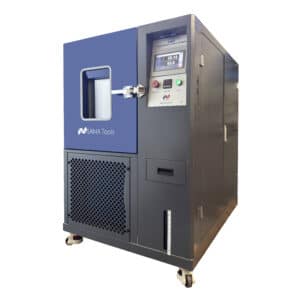
The SAUV856 UV light chamber uses fluorescent UV lamps to expose materials, coatings and components to controlled cycles of ultraviolet light, condensation and water spray.
It is designed to assess how a material may change when exposed over time to light, humidity and temperature variations. During the test, discoloration, gloss loss, cracking, fissures, chalking, oxidation or other surface alterations may occur.
The accelerated UV aging test makes it possible to compare, in a shorter time, the behaviour of materials, formulations and coatings exposed to the same conditions. Test hours do not automatically correspond to a specific real outdoor service life: the result must be interpreted in relation to the material, the applied cycle and the requirements of the specification used.
Accelerated UV aging of materials and coatings
The UV chamber combines ultraviolet radiation with condensation and water-spray cycles. Alternating these factors makes it possible to reproduce conditions that may contribute to the degradation of materials exposed outdoors or to critical environmental conditions.
UV light mainly affects paints, coatings, polymers, plastics, rubber, treated wood, decorative finishes and components intended to receive natural light. Condensation exposes samples to a highly humid environment, while water spray introduces phases comparable to rain and rapid surface cooling.
This combination is useful for comparing different samples, assessing formulation changes, verifying the response of a protective finish and identifying alterations that may appear after prolonged exposure.
UVA or UVB lamps: which configuration should be selected
The SAUV856 can be supplied with UVA-340 or UVB-313 lamps, to be selected according to the objective of the test.
UVA-340 lamps are normally used when a more representative reproduction of the short-wave UV component of sunlight is required. They are suitable for weathering tests on paints, coatings, plastics and other materials intended for outdoor use.
UVB-313 lamps emit more severe UV radiation than that normally present in sunlight. They can accelerate degradation to a greater extent and are mainly used for comparative checks, research and development, or tests on materials with high weathering resistance. Results obtained with UVB must be assessed considering that the effects may be less representative of natural exposure.
Condensation and spray to simulate humidity and rain
During the condensation cycle, the chamber creates high-humidity conditions that promote condensation on the samples. This phase is useful for assessing material behaviour when exposed to prolonged humidity, as may occur with dew and condensation.
The spray function introduces programmable water sprays onto the test panels. Water can help simulate the effect of rain and rapid thermal changes that occur, for example, when a hot surface is cooled suddenly.
The option to alternate UV irradiation, condensation and spray makes it possible to set more complete cycles than exposure to ultraviolet light alone.
Irradiance and exposure temperature control
The UV energy received by the sample is a key parameter in accelerated aging tests. In the SAUV856, irradiance can be set from 0.1 to 1.55 W/m² and is automatically regulated during the cycle.
The system compensates for the natural reduction in lamp output over time, helping maintain more consistent exposure conditions and making results obtained on different materials, coatings or formulations more comparable.
The chamber also controls black panel temperature, using a reference exposed to the same conditions as the test panels. This value makes it possible to monitor surface exposure temperature during the test, an important parameter for correctly interpreting sample behaviour.
Test programming and data collection
The touch screen makes it possible to set and control the phases of the test cycle, managing irradiance, temperature, condensation and spray parameters according to application requirements.
Data are collected during test execution and can be exported via USB in spreadsheet format. The Ethernet TCP/IP interface also allows remote monitoring of chamber status.
The USB and Ethernet TCP/IP interfaces allow test data to be collected and exported, improving cycle traceability and reducing transcription errors in quality-control processes.
UV chamber for testing several samples at the same time
The SAUV856 has an exposure area that can accommodate up to 48 standard samples measuring 75 × 150 mm. This capacity makes it possible to organise comparisons between different materials, colours, finishes or samples from different suppliers in the same test cycle.
The choice of configuration must consider the required lamp type, the number of test panels, irradiance conditions, the use of condensation or spray, and the level of documentation required for internal control.
For smaller quantities of samples and benchtop UV tests, the SAUV852 UV test chamber is available, equipped with a rotating drum to expose test panels uniformly. When the method requires a Xenon source instead of fluorescent UV lamps, the Xenon chambers SAXT865 and SAXT866 can be considered.
UV tests on coatings, plastics and materials exposed outdoors
The SAUV856 can be used for tests set according to ISO 16474-3 or ASTM D4587 on paints, varnishes and related coatings. For plastics and polymeric materials, applicable references may include ISO 4892-3 and ASTM D4329.
The choice of cycle, light source, temperature and condensation or spray phases must depend on the material specification, application sector and test objective. Standards or test procedures should not be selected generically, but in relation to the component actually being assessed.
Calibration report available on request, to accompany the UV light chamber with metrological documentation useful for internal checks and for monitoring its status over time.
Applications
- UV aging tests on paints, coatings and surface finishes
- Assessment of plastics, polymers, rubber and composite materials
- Tests on automotive and motorcycle components, and parts intended for outdoor use
- Checks on materials for construction, windows and doors, outdoor furniture and architectural components
- Verification of painted panels, protective coatings and surface treatments
- Tests on wood, decorative materials and coated surfaces
- Comparison between materials, formulations, painting cycles and suppliers
- Research and development of components exposed to light, humidity and temperature variations
- Tests on accessories, finishes and components for the fashion and luxury sector, when exposed to light or critical environmental conditions
FAQ – UV light chamber
What is a UV light chamber?
A UV light chamber is equipment that uses ultraviolet lamps to expose materials and coatings to accelerated aging cycles. It can combine UV light, condensation and water spray to assess sample behaviour under controlled environmental conditions.
What is a UV aging test used for?
It is used to compare the behaviour of materials, paints, coatings and components exposed to light, humidity and temperature variations. It makes it possible to observe alterations such as discoloration, cracking, gloss loss, chalking and surface degradation.
What is the difference between UVA-340 and UVB-313 lamps?
UVA-340 lamps reproduce the UV component of sunlight more representatively and are generally used for weathering tests. UVB-313 lamps create more severe and accelerated exposure, but may produce effects that are less representative of natural exposure.
Do UV test hours correspond to the actual outdoor service life of the material?
No. In the SAUV856, the cycle can combine UV radiation, black panel temperature, condensation and water spray. These conditions accelerate degradation assessment, but do not make it possible to directly convert exposure hours into years of actual use. The result must be assessed in relation to the material, the selected UVA or UVB lamp, cycle parameters and the criteria established by the test.
Which effects can be checked after a cycle with the SAUV856?
The assessment can take into account sample behaviour after UV radiation, condensation and spray phases. Depending on the test plan, colour variation, gloss changes, blistering, cracking, coating degradation, adhesion loss or other variations in surface properties can be checked.
What are condensation and spray used for?
Condensation creates high-humidity conditions and promotes condensation on the samples. Spray introduces water-spray phases that can simulate rain and rapid surface cooling.
Why is irradiance control important?
Irradiance determines the UV energy received by the samples. Keeping it under control helps make exposure conditions more consistent and results from tests carried out at different times more comparable.
What is black panel temperature?
It is the temperature measured on a black panel exposed to the same conditions as the test panels. It is used as a reference to monitor surface exposure temperature during the UV cycle.
Does the SAUV856 record test data?
Yes. Data are collected during the test and can be exported via USB in spreadsheet format.
Can the UV chamber be monitored remotely?
Yes. The chamber features an Ethernet TCP/IP interface for remote monitoring of operating status and test progress.
How many test panels can the chamber accommodate?
The SAUV856 can accommodate up to 48 standard samples measuring 75 × 150 mm.
Is a calibration report available?
Yes, a calibration report is available on request.
Fill out the form below to contact us.
"*" indicates required fields