The salt spray test is widely used to assess the corrosion resistance of coated samples, finished surfaces and metal components. Coatings, electroplated treatments and surface finishes are exposed to a controlled corrosive environment to evaluate their performance over the specified exposure time.
The salt spray test is an accelerated corrosion test that exposes samples to highly corrosive conditions. The appearance of oxides, corrosion, coating defects or other alterations is assessed at the end of the period established by the test plan.
Exposure time and assessment criteria are not universal: they depend on the applicable standard, the coating specification, the material and the requirements for the specific component. Test duration must therefore be interpreted in relation to the specification or procedure in use.
Salt spray fog cabinets are used in industry to assess the corrosion resistance of surfaces, treatments and finished parts in processes where the behaviour of a component needs to be verified in the presence of humidity, saline atmosphere and corrosive agents.
The equipment consists of a closed test chamber in which a saline solution is atomised through a nozzle. In NSS tests, a 5% sodium chloride solution is normally used to create a controlled salt spray environment around the samples.
Tests using a neutral saline solution are identified as NSS, meaning neutral salt spray. Acetic acid salt spray AASS and copper-accelerated acetic acid salt spray CASS tests are also available. The choice of method depends on the material, the type of coating and the applicable technical specification.
Salt spray cabinets for controlled and repeatable testing
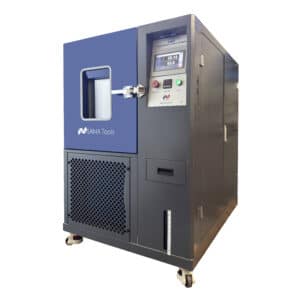
Salt spray fog cabinets in the SASSC series are designed to expose samples and test panels to a corrosive fog distributed inside the test chamber.
The PVC construction is suitable for the corrosive environment of the test, while the transparent V-shaped lid is designed to limit condensation dripping onto the samples. This is important because it helps maintain more consistent exposure conditions during the test.
The sample racks allow test panels to be positioned at the angle required by the standard. The glass nozzle and atomising tower promote fog distribution inside the chamber, while the collectors make it possible to monitor the amount of fog produced during the test.
Temperature, spraying and cycle pause control makes it possible to set conditions consistent with the selected test method. At the end of exposure, the fog exhaust system facilitates chamber management before opening.
NSS, AASS and CASS tests according to ISO 9227
ISO 9227 is the main reference standard for corrosion tests in artificial atmospheres using salt spray. It defines the general conditions for NSS, AASS and CASS tests, to be used according to the material and coating being assessed.
The NSS test is used for checks on metals, metallic coatings, zinc coatings, paint finishes, conversion treatments and organic coatings applied to metal substrates.
The AASS test is used when the applicable specification requires acetic acid salt spray, while the CASS test is used for more severe checks on specific decorative coatings and surface treatments.
For pre-painted metals and organic coatings on metal substrates, EN 13523-8 may also be relevant. When the test plan concerns plastic materials or non-metallic components, ISO 4611 may be referenced instead.
Which salt spray cabinet should you choose
The series includes four models, mainly differentiated by chamber capacity, usable dimensions and the number of test panels that can be handled.
The SASSC880 has a capacity of 108 litres and is suitable for laboratories and quality departments carrying out tests on limited quantities of test panels or smaller parts.
The SASSC881, with a capacity of 270 litres, offers more internal space for a higher number of samples or components with larger overall dimensions.
The SASSC882 features a 480-litre chamber and is suitable when tests need to be organised on larger batches or more voluminous parts. It is equipped with pneumatic lid opening.
The SASSC883 has a capacity of 800 litres and is suitable for testing many samples at the same time or components of considerable size. This model also features pneumatic lid opening.
The choice of salt spray cabinet should therefore consider not only the number of samples, but also their dimensions, test frequency, available laboratory space and the need to manage several batches in the same cycle.
Preparation of scribed test panels before salt spray testing
When the coating specification or test plan requires the test panel to be scribed, sample preparation affects the comparability of the result.
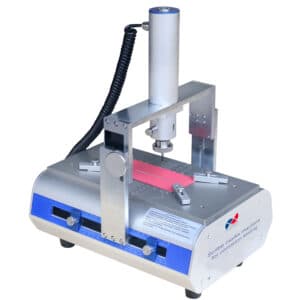
Manual scribing can introduce differences related to operator pressure, speed and angle. For this reason, when several test panels need to be prepared with consistent scribe marks, the SASMM539 test panel scribing machine can be used.
The SASMM539 makes it possible to obtain uniform and repeatable scribe marks, reducing variability between samples before exposure in the salt spray cabinet. It is a useful complement for companies carrying out tests on painted, electroplated or surface-treated coatings.
Internal checks on coatings, finishes and accessories
A salt spray cabinet makes it possible to organise corrosion tests internally on coatings, accessories, small parts and finished components, reducing the waiting time involved in sending samples to external laboratories.
It is useful for assessing the resistance of finishes intended for humid, marine or industrial environments, or conditions characterised by the presence of corrosive agents. Tests can help identify critical issues in treatments, materials and coatings during component development, supplier qualification or production control.
Proper test management, from sample preparation to cycle selection and final assessment, helps obtain results that are more consistent and comparable over time.
Calibration report available on request, to accompany the salt spray cabinet with metrological documentation useful for internal checks and for monitoring its status over time.
Applications
- Corrosion resistance checks on metallic and organic coatings
- Assessment of electroplated treatments, zinc coatings, nickel plating, chrome plating and other surface finishes
- Tests on liquid paints, powder coatings, primers and protective coatings
- Checks on small parts, hardware, accessories, metal components and finished items
- Quality control of fashion accessories, furniture items, taps and decorative components
- Tests on components for automotive, motorcycles, industrial vehicles and operating machinery
- Assessment of parts intended for systems, outdoor environments, marine applications or high-humidity conditions
- Checks on components for construction, windows and doors, metal structures, household appliances and industrial equipment
- Checks on samples, test panels and finished components during development, coating qualification and production control
- Preparation and exposure of scribed test panels where required by the applicable specification
FAQ – Salt spray fog cabinets
What is a salt spray fog cabinet?
A salt spray fog cabinet is equipment used to expose samples and components to a controlled corrosive fog. It is used to assess the behaviour of materials, coatings and surface treatments during accelerated corrosion testing.
What is a salt spray test used for?
The test is used to verify the corrosion resistance of surfaces, coatings and finished components. It is used to compare different treatments, check the quality of finishes and assess the behaviour of a component according to a defined test plan.
What is the difference between NSS, AASS and CASS?
NSS indicates neutral salt spray, AASS indicates acetic acid salt spray and CASS indicates copper-accelerated acetic acid salt spray. The method is selected according to the material, the type of coating and the applicable technical specification.
Does ISO 9227 define how many hours the test must last?
No. ISO 9227 defines the test conditions, but exposure duration, test panel type and assessment criteria must be established by the component specification, the requirement document or the applicable product standard.
Do salt spray test hours correspond to the actual service life of the component?
No. The salt spray test is an accelerated test and does not automatically translate into an actual service life. The result must be assessed in relation to the material, the coating and the requirements specified for that component.
How are test panels assessed at the end of a salt spray test?
At the end of exposure, test panels are examined according to the criteria specified by the applicable specification. Assessment may include the appearance of corrosion products, the degree of rusting on ferrous substrates, blistering, coating detachment or degradation, and corrosion propagation at the scribe mark, where present.
How should cabinet capacity be selected?
The choice depends on the number of samples, their dimensions, test frequency and the need to manage several batches at the same time. The series includes 108, 270, 480 and 800-litre models.
When should a test panel be scribed before testing?
Scribing is carried out when required by the coating specification or test plan. It is useful for assessing the behaviour of surface protection along a controlled scribe mark.
Why use a test panel scribing machine?
A test panel scribing machine makes it possible to obtain more uniform and repeatable scribe marks than manual preparation. This helps reduce variability between samples and makes test results more comparable.
Which materials and coatings can be checked?
Salt spray fog cabinets are used for metal components, electroplated coatings, zinc coatings, nickel plating, chrome plating, paint finishes, conversion treatments, decorative finishes and other protective systems compatible with the test plan.
Is a calibration report available?
Yes, a calibration report is available on request.
Fill out the form below to contact us.
"*" indicates required fields