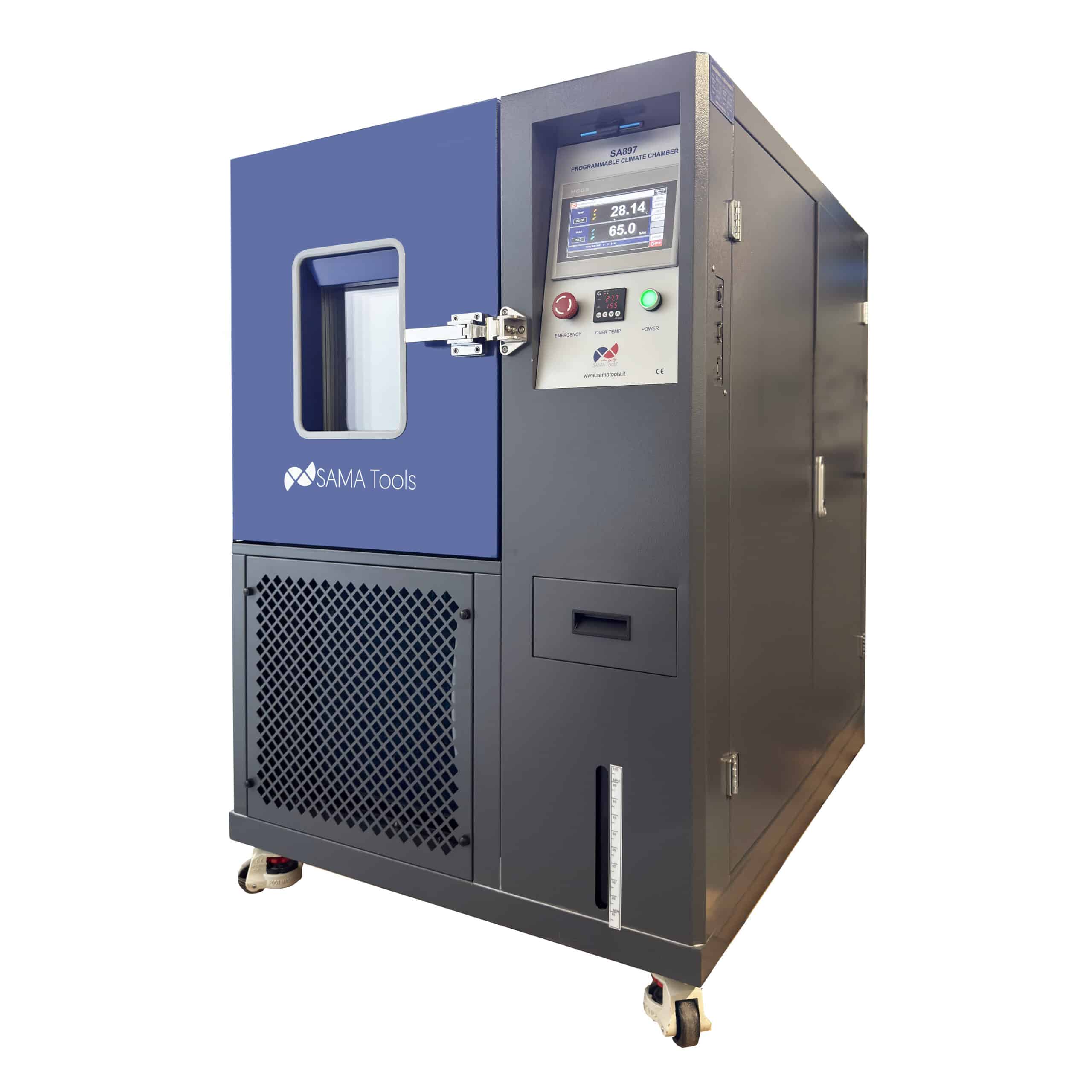
The SA897 climate chamber is designed to simulate controlled environmental conditions and assess the behaviour of materials, components and products subjected to changes in temperature and humidity.
It is a solution for quality laboratories, research and development departments, and production areas that need to carry out climate tests on samples, packaging, components and finished products, assessing their stability, resistance and ability to maintain performance over time.
What are climate chambers?
Climate chambers are equipment used to expose samples, materials or products to controlled environmental conditions.
By regulating temperature and relative humidity, they make it possible to reproduce constant conditions or conditions that vary over time in the laboratory. This makes it possible to observe the behaviour of samples during stability, conditioning, ageing and performance-verification tests.
The SA897 can be used as a laboratory climate chamber and as a humidity chamber for tests requiring combined control of both parameters.
Temperature and humidity testing with programmable cycles
The SA897 climate chamber integrates heating, cooling, humidification and dehumidification systems to create controlled environmental conditions inside the test chamber.
The touch-screen control allows constant-value tests or programmable cycles with variations in temperature and humidity to be set. During the test, the set values, detected conditions, test duration and test trend can be viewed.
This mode is useful when the sample must be subjected to several consecutive climate phases, for example by alternating different temperature and humidity conditions to assess the response of materials, finishes, components or packaging.
Test monitoring and remote LAN control
The SA897 climate chamber is supplied with monitoring software and features a LAN interface for remote control and test-data management.
The LAN interface allows connection to software for test-data collection, improving traceability and reducing transcription errors in quality-control processes.
Temperature and humidity curves can be viewed and stored, making it easier to document the cycle trend, compare different tests and retain a record of the conditions applied to the samples.
Which SA897 climate chamber should you choose
Six models are available, differentiated by internal capacity and temperature range.
The SA897-100B, SA897-100C and SA897-100D models have a capacity of 100 litres and are suitable for smaller samples, test panels and components.
The SA897-225B, SA897-225C and SA897-225D models feature a 225-litre chamber, which is useful when larger components need to be tested or when tests need to be organised on several samples at the same time.
The difference between B, C and D versions concerns the available temperature range:
- SA897-100B and SA897-225B: from -20 °C to +150 °C
- SA897-100C and SA897-225C: from -40 °C to +150 °C
- SA897-100D and SA897-225D: from -60 °C to +150 °C
For all models, relative humidity can be controlled from 20 to 98% RH.
The choice should start from the minimum temperature required by the test, the actual volume of the samples, the number of items to be tested in the same cycle and the need to run constant conditions or more complex climate programmes.
Temperature and relative humidity influence each other: at lower temperatures, the controllable humidity range may be more limited. The usable combination must therefore be assessed according to the climatic conditions required by the individual test.
Climate chamber designed for laboratory testing
The chamber interior is made of stainless steel and features air recirculation with top-down distribution, a configuration that helps promote more uniform conditions throughout the test volume.
Two adjustable stainless steel shelves make it possible to organise the space according to sample dimensions. The anti-fog window and internal lighting allow the inside of the chamber to be observed during testing.
The structure is designed for continuous use in laboratories and departments dedicated to quality control, product development and environmental performance assessment.
Climate tests for materials, components and packaging
The SA897 climate chamber makes it possible to carry out in-house tests on materials, components and finished products, reducing the time needed to assess design changes, process variations or new packaging solutions.
It can be used to compare materials, suppliers, coatings, components and construction configurations, identifying any critical issues before use, production or delivery.
The climate chamber is also suitable for use in tanneries, where it can be used to assess the behaviour of leather, finishes, coatings and accessories as temperature and humidity vary, during product development and internal checks.
The climate chamber can also be used to check accessories intended for the fashion and luxury sector, assessing the behaviour of finishes, coatings, materials and components under changes in temperature and humidity.
When the check instead concerns corrosion resistance in the presence of salt spray, the test requires a salt spray cabinet from the SASSC series. The two solutions can be complementary: the SA897 for controlled temperature and humidity, and the SASSC salt spray cabinet for exposure to a corrosive saline atmosphere.
Calibration report available on request, to accompany the climate chamber with metrological documentation useful for internal checks and for monitoring its status over time.
Applications
- Climate tests on materials, components and finished products
- Tests on leather, finishes, coatings and accessories in the tanning industry
- Checks on accessories, finishes and components for the fashion and luxury sector
- Temperature and humidity tests on packaging, packs and containers
- Checks on electrical and electronic components, sensors, boards and devices
- Tests on automotive, motorcycle, household-appliance and industrial-equipment components
- Assessment of plastics, composites, rubber, textiles and surface finishes
- Checks on coatings, accessories and components intended for humid environments or subject to temperature changes
- Research and development of new materials, products and design solutions
- Tests on products and packaging for the textile, food, cosmetics and pharmaceutical sectors
- Internal monitoring of climate cycles through software and remote LAN control
FAQ – Climate chambers
What is a climate chamber?
A climate chamber is equipment used to create controlled temperature and humidity conditions, useful for assessing the behaviour of materials, components, packaging and finished products.
What is a humidity chamber used for?
A humidity chamber is used to control relative humidity together with temperature. It is used for tests in which the sample must be exposed to defined environmental conditions maintained over time.
What is the difference between a climate chamber and a thermostatic chamber?
The SA897 climate chamber controls both temperature and relative humidity. A thermostatic chamber, on the other hand, is used when the test requires temperature control only.
Which model should be selected between 100 and 225 litres?
The 100-litre models are suitable for small test panels and samples. The 225-litre versions offer more internal space and are preferable when larger components or more items need to be tested in the same cycle.
What is the difference between B, C and D models?
The difference concerns the minimum achievable temperature: B models reach -20 °C, C models reach -40 °C and D models reach -60 °C. All versions reach +150 °C.
Can temperature and humidity be set in any combination?
No. Temperature and relative humidity are linked: as temperature decreases, the air can contain less humidity. For this reason, not all humidity percentages can be maintained at lower temperatures. The combination to be set must therefore be assessed according to the test conditions and the climatic range controllable by the chamber.
Can the chamber run programmable cycles?
Yes. The SA897 allows constant conditions or cycles with programmed variations in temperature and humidity to be set, useful for simulating different environmental conditions during the same test.
Is the monitoring software included?
Yes, monitoring software is included as standard and allows the data and curves generated during testing to be viewed.
Can the climate chamber be controlled remotely?
Yes. The LAN interface allows remote monitoring and control of the chamber, as well as management of the data collected during test cycles.
What is the difference between a climate chamber and a salt spray cabinet?
A climate chamber controls temperature and humidity for environmental tests. A salt spray cabinet, on the other hand, is designed to expose samples to a corrosive atmosphere generated by atomising a saline solution.
Is a calibration report available?
Yes, a calibration report is available on request.
To ask for a quote for climate chambers, return to the top of the page and select the red “Request a Quote” option.
Fill out the form below to contact us.
"*" indicates required fields