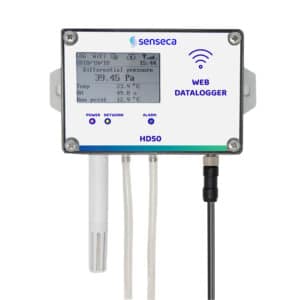
The wireless datalogger is a cable-free monitoring system designed to acquire, store and transmit a wide range of physical parameters in industrial environments, laboratories, warehouses, cleanrooms, museums, greenhouses, HVAC systems, meteorological applications and sensitive goods transport.
The HD35 series is not based on a single instrument, but on a complete modular system. The configuration can include one or more HD35ED acquisition units, one HD35AP base unit and HD35AP-S software for data management. Remote dataloggers acquire measurements through integrated or external sensors, store values in internal memory and transmit them via radio to the base unit.
The system can monitor temperature, relative humidity, atmospheric pressure, differential pressure, illuminance, UVA, UVB and UVC irradiance, CO2, solar radiation, precipitation, wind speed and direction, leaf wetness, volumetric water content in soil, level and WBGT index, depending on the selected models and probes.
For applications requiring industrial signal integration, versions with terminal analog inputs are also available. These allow connection of transmitters with current or voltage output, Pt100/Pt1000 sensors, K, J, T, N and E thermocouples, sensors with clean contact output, potentiometric signals and RS485 MODBUS-RTU sensors. This feature allows already-installed transmitters to be integrated into the system.
Communication between dataloggers, repeaters and the base unit is performed via radiofrequency. The system can include up to 255 devices, including base units, repeaters and dataloggers. HD35RE wireless repeaters extend wireless coverage when distances are long, installations are distributed across several floors or obstacles such as walls, metal structures or separate buildings are present.
The base unit can be selected according to the required connection type: USB, RS485 with MODBUS-RTU protocol, Ethernet, Wi-Fi, GSM/GPRS or 3G/GPRS. This allows creation of simple systems connected to a PC, PLC-integrated systems, installations with remote data transmission, FTP upload or monitoring of unattended sites.
Each datalogger can be configured with its own measuring interval and logging settings. Data remain stored both in the internal memory of the datalogger and, after transmission, in the memory of the base unit. This dual storage system reduces the risk of data loss and avoids the need for the PC to remain permanently connected.
The HD35AP-S software allows complete system configuration, real-time measurement display, monitoring of device status, RF signal strength and battery level, data download and database archiving. The database can also be used on a local network, allowing data consultation from multiple workstations.
Alarm management allows setting one high threshold and one low threshold for each monitored quantity, with configurable hysteresis and delay. In case of limit exceedance, the alarm can be signalled by the datalogger buzzer, viewed on the PC, sent via email or SMS in enabled configurations, or managed through the HD35ED-ALM remote module with relay outputs for activation of sirens, warning lights or other devices.
Versions with LCD display allow direct visualization on the datalogger of measurements, logging status, battery level, radio signal quality and the main operating information. Versions without display are instead intended for more essential configurations where consultation mainly takes place via PC or remote access.
The system complies with EN 12830 for dataloggers and, with the HD35AP-CFR21 software option, can be used in applications requiring data management and traceability according to FDA 21 CFR Part 11 recommendations. This option is particularly useful in pharmaceutical environments, laboratories, cleanrooms and processes where data integrity, audit trail and access management are critical elements.
Compared to a single datalogger, the HD35 system is suitable when several measurement points distributed over distant areas must be monitored, or when a scalable network is required that can be modified over time and integrated with different sensors. Configuration choice depends on the quantities to be measured, the number of points, the installation environment, radio coverage and the required connection type to PC, PLC, cloud or company network.
Applications
- Monitoring of temperature and humidity in warehouses, cold rooms, storage areas and transport
- Environmental monitoring in pharmaceutical applications, medical laboratories, cleanrooms and controlled rooms
- Monitoring in museums, historical archives, public buildings, schools and offices
- HVAC, ventilation, air conditioning and climate control system verification
- Greenhouse, agriculture, meteorology and hydrology monitoring
- Monitoring of solar radiation, precipitation, wind, leaf wetness and soil moisture
- Control of CO, CO2, pressure, illuminance and UV irradiance
- Acquisition of data from transmitters with analog output, clean contacts, Pt100/Pt1000 sensors and thermocouples
- Monitoring of industrial processes and systems distributed over several areas or buildings
- Local, remote and relay-output alarm management
FAQ – Wireless datalogger
What is a wireless datalogger used for?
It is used to measure and record physical parameters in several locations without wiring every sensor directly to the PC. Remote dataloggers acquire the data, store them and transmit them via radio to the base unit.
Which components make up the HD35 system?
The system consists of one HD35AP base unit, one or more HD35ED remote dataloggers, optional HD35RE repeaters and, when required, the HD35ED-ALM remote alarm module.
How many devices can the system manage?
The system can include up to 255 devices, considering base units, repeaters and dataloggers. The effective number of manageable dataloggers also depends on transmission interval and network structure.
Which parameters can it monitor?
Depending on the selected models, it can monitor temperature, humidity, atmospheric and differential pressure, illuminance, UV irradiance, CO, CO2, solar radiation, rain, wind, leaf wetness, soil moisture, level and WBGT.
Can external sensors or transmitters be connected?
Yes, some models include terminal inputs for current and voltage transmitters, Pt100/Pt1000 sensors, clean contacts, potentiometric signals and RS485 MODBUS-RTU sensors.
When are wireless repeaters required?
Repeaters are useful when the distance between dataloggers and the base unit is long or when walls, floors or other obstacles reduce radio signal quality.
Can the system send alarms?
Yes, high and low alarm thresholds can be configured for each measured quantity. Alarm conditions can be signalled locally, viewed on the PC, sent via email or SMS in enabled versions, or managed through remote relay modules.
Does the PC need to remain permanently connected?
No, measurements are stored in the internal memory of the dataloggers and also in the base unit. The PC can be connected only when data need to be downloaded, viewed or managed.
Which base unit should be selected?
It depends on the required connection type. Versions are available with USB, RS485 MODBUS-RTU, Ethernet, Wi-Fi, GSM/GPRS or 3G/GPRS. Selection depends on the available network, distance, PLC integration requirements or remote data transmission needs.
Is it suitable for pharmaceutical applications?
Yes, the system can also be used in pharmaceutical environments and cleanrooms. With the HD35AP-CFR21 software option, data and configuration can be managed according to FDA 21 CFR Part 11 recommendations.
Does the system comply with any standards?
The documentation specifies EN 12830 compliance for dataloggers. In addition, the advanced CFR21 software option is designed according to FDA 21 CFR Part 11 recommendations.
Do dataloggers include a display?
It depends on the version. Some models are available with LCD display, useful for viewing measurements, radio signal quality, logging status and battery condition directly at the installation point.
When should a wireless system be chosen instead of a wired one?
Wireless systems are recommended when measurement points are numerous, far apart or difficult to cable. Wireless reduces installation time and allows dataloggers to be repositioned more easily if the control point layout changes.
Fill out the form below to contact us.
"*" indicates required fields