

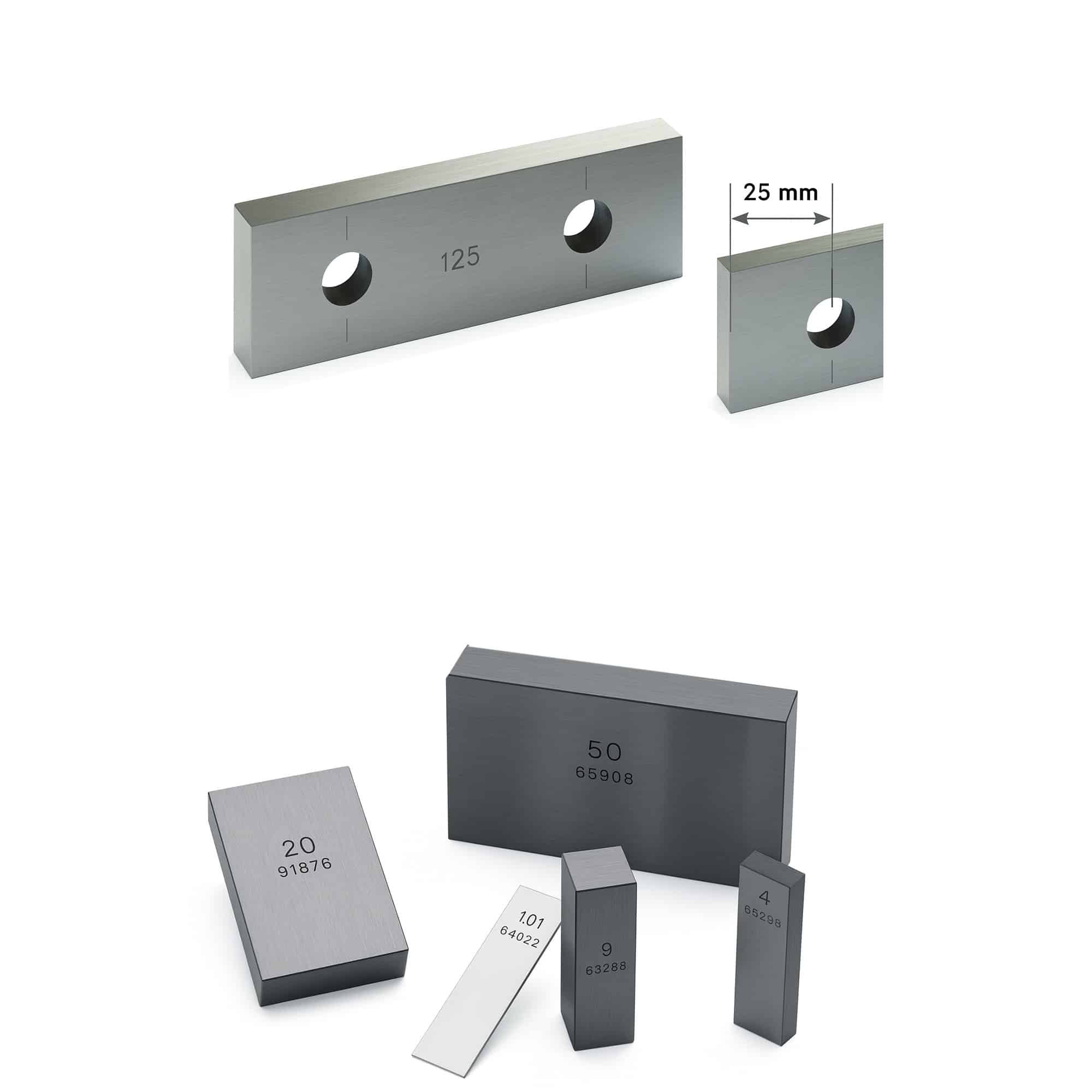
Steel gauge blocks are precision length standards used in metrology and quality control applications for dimensional inspection, accuracy verification of measuring instruments and calibration operations. Also known as gauge blocks or Johnson gauge blocks, they represent a fundamental reference in measurement processes where a stable and reliable nominal value is required.
These instruments are rarely used individually and are generally supplied in sets with different dimensions arranged according to an arithmetic progression.
This configuration allows several gauge blocks to be combined together, obtaining multiple intermediate dimensions with a limited number of elements and making them extremely versatile for dimensional inspection applications.
Fundamental for the calibration and verification of the accuracy of other measuring instruments, they guarantee high metrological standards in quality control processes.
Unlike complete sets, single gauge blocks are particularly suitable when a specific dimension is required to complete an existing set, replace a missing element, provide a dedicated size for recurring inspections or perform measurements related to individual nominal dimensions. This solution is useful both in metrology laboratories and in production environments where specific single dimensions may be required.
One of the key characteristics of gauge blocks is the possibility of wringing them together to obtain dimensional combinations starting from a reduced number of elements. This property makes them extremely versatile for dimensional inspection and calibration operations, allowing the creation of numerous intermediate dimensions depending on the application requirements.
Gauge blocks are available in a wide dimensional range, from 0.50 mm up to 1000 mm, in grade 0 and grade 1, covering different metrological and application requirements.
Dimensional and metrological characteristics comply with ISO 3650.
For lengths from 125 mm onwards, holes are provided to facilitate clamping and assembly with other elements through a gauge blocks connector.
The technical data sheet includes flatness tolerances and metrological characteristics at 20 °C for the different grades, together with usage indications:
- Grade 1 for calibration of instruments such as calipers and micrometers
- Grade 0 for use in climate-controlled environments and metrology laboratories
- Grade K for calibration of highly accurate instruments and inspection of lower-grade gauge blocks
Steel gauge blocks are widely used in metrology laboratories, quality control departments and calibration activities, where they serve as reference standards for the inspection of calipers, micrometers and other measuring instruments.
Gauge blocks can also be used together with gauge block packers, accessories that allow multiple elements to be assembled into stable and precise length combinations for dimensional inspection applications. This configuration makes them particularly suitable for internal and external measurements and for calibration of measuring instruments such as calipers, micrometers, dial bore gauges and other measuring devices.
Upon request, they can be supplied with a calibration report or ACCREDIA certificate.
Applications
- Dimensional inspection using length standards
- Calibration and verification of calipers, micrometers and other measuring instruments
- Integration or replacement of individual elements in existing sets
- Use as metrological reference standards in laboratories and production environments
FAQ – Steel gauge blocks
What are gauge blocks?
Gauge blocks are precision length standards used for dimensional inspection and calibration of measuring instruments such as calipers, micrometers and dial bore gauges.
What are gauge blocks used for?
They are used for calibration and inspection of measuring instruments and for dimensional verification with a stable and reliable reference.
Can gauge blocks be combined together?
Yes, they can be wrung together to obtain different dimensional combinations, allowing the creation of multiple intermediate sizes.
Can they be used with gauge block packers?
Yes, by using gauge block packers it is possible to assemble multiple blocks together to create precision length standards for internal and external measurements and instrument calibration.
What is the difference between grade 0 and grade 1?
Grade 1 is suitable for calibration of measuring instruments, while grade 0 is intended for use in climate-controlled environments such as metrology laboratories.
Do gauge block sets comply with a standard?
Yes, dimensional and metrological characteristics comply with ISO 3650.
Are they available with certification?
Yes, gauge blocks can be supplied with a calibration report or ACCREDIA certificate.
What are certified gauge blocks?
Certified gauge blocks are reference standards supplied with a calibration report or ACCREDIA certificate confirming their dimensional and metrological characteristics. They are used where traceability and conformity are required in quality control and calibration activities.
When is it preferable to purchase single gauge blocks instead of a set?
Single gauge blocks are recommended when a specific dimension is needed to complete an existing set, replace a missing element or perform recurring inspections on a dedicated nominal size. Complete sets are more suitable when a wide measuring range and multiple dimensional combinations are required.
In which applications are gauge blocks most commonly used?
Gauge blocks are mainly used in metrology laboratories and production environments for calibration and inspection of instruments such as calipers, micrometers and dial bore gauges, as well as for dimensional verification and accuracy checks in manufacturing processes.
Fill out the form below to contact us.
"*" indicates required fields


