

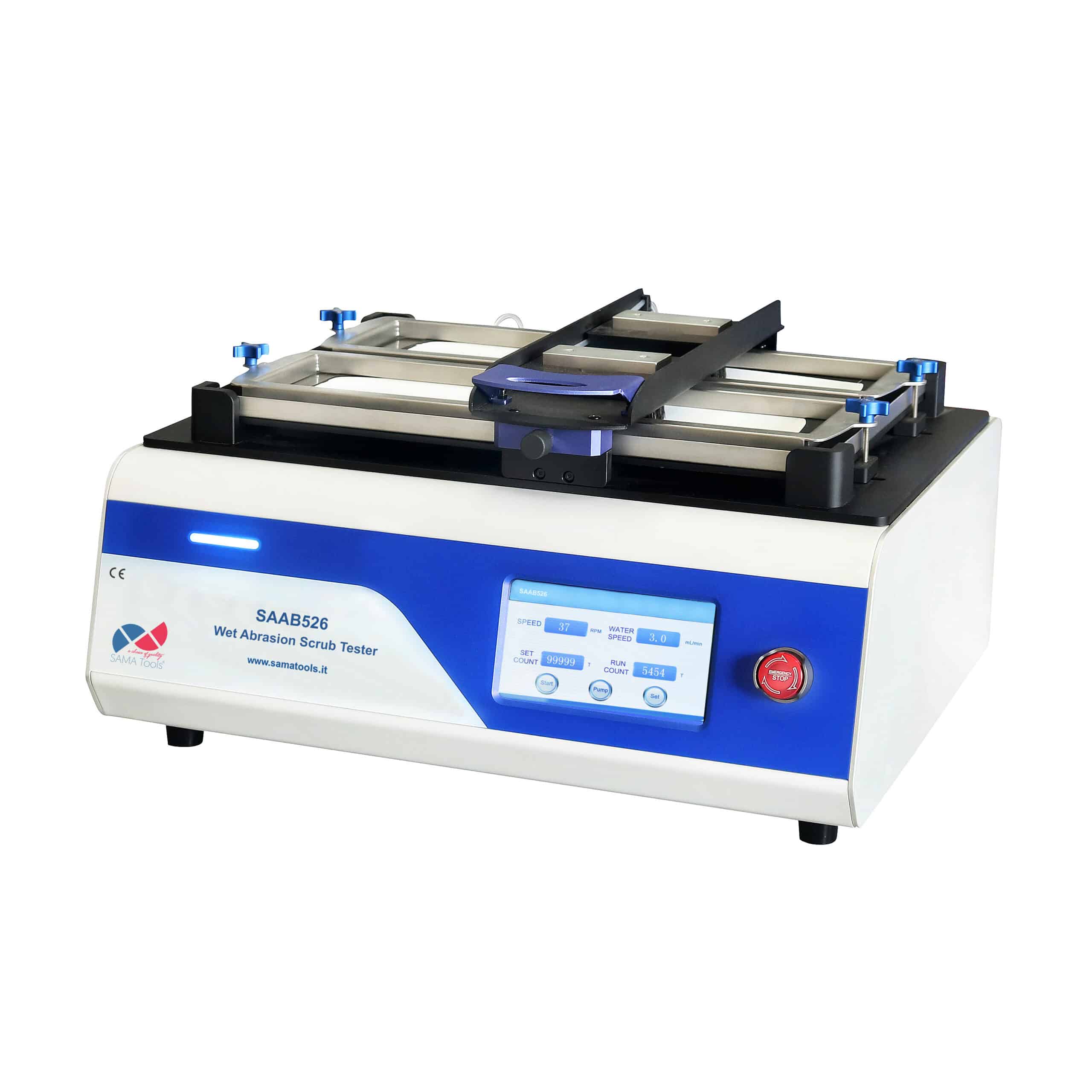
The two-channel multifunction abrasion scrub testers are designed to perform linear abrasion, washability and scrub-resistance tests on paints and coatings. Thanks to the availability of different test heads, this range offers considerable versatility for laboratory testing and quality-control applications, where the response of a coated surface to repeated rubbing, cleaning or wet-abrasion cycles needs to be evaluated.
An abrasion scrub tester for paints and coatings makes it possible to verify how effectively an applied film retains its surface characteristics when subjected to repeated contact with a brush, sponge or abrasive pad. Depending on the test method used, the evaluation can identify wear, changes in appearance, loss of coating or differences in cleanability.
The operating principle involves securing the coated sample on the test platform and subjecting it to the reciprocating movement of the selected test head. Depending on the configuration, testing can be performed either dry or with a controlled supply of liquid, reproducing conditions associated with washability, wet abrasion, scrub resistance or dirt-removal testing.
A distinctive feature of these abrasion testers is the presence of two operating channels, allowing the test to be performed on two surface paths during the same test cycle. This solution is useful when comparing two samples, checking different areas of the same panel or managing repeated tests on paints and coatings more efficiently.
The range is intended for coatings whose performance needs to be evaluated during cleaning or rubbing conditions. Typical applications include washable paints, protective finishes, coatings applied to test panels and coated surfaces designed to be cleaned or exposed to repeated contact during use.
Different configurations are available depending on the required test method and the type of mechanical action required:
- SAAB526/1, with a nylon brush, for scrub-resistance tests in accordance with ASTM D2486
- SAAB526/2, with an abrasive pad, for wet-abrasion and cleanability tests in accordance with ISO 11998
- SAAB526/3, with a sponge, for tests in accordance with ASTM D3450
- SAAB526/4, with a sponge and abrasive pad, for tests in accordance with ASTM D4213
- SAAB526/5, with a sponge, for evaluating cleanability and dirt pickup resistance in accordance with ASTM D4828
- SAAB526/6, with a bristle brush, for specific testing requirements involving this type of head
- SAAB527, configured with a nylon brush and abrasive pad to provide, in one instrument, the configurations intended for tests in accordance with ASTM D2486 and ISO 11998
The SAAB527 model is particularly suited to laboratories that need to perform both brush-based scrub-resistance tests and wet-abrasion tests with an abrasive pad. Having both configurations available on the same instrument makes it possible to address different inspection requirements while using the same two-channel testing platform.
Test parameters can be set using the touchscreen, allowing the operator to configure the test and monitor its progress easily. The adjustable-flow pump also allows liquid dosing to be managed during wet-abrasion or washability tests, helping maintain more controlled operating conditions.
Abrasion and rubbing tests can be used both during coating development and for production quality-control checks. Comparing samples produced with different formulations or application cycles makes it possible to assess finish resistance under simulated conditions and identify the solution that is most consistent with the intended application.
The two-channel multifunction abrasion scrub testers offer a versatile solution for evaluating paints and coatings through linear-abrasion, washability, cleanability and scrub-resistance testing. The appropriate configuration can be selected according to the specific test method required.
Applications
- Linear abrasion tests on paints and coatings
- Wet-abrasion tests on paints and coatings
- Assessment of paint washability
- Inspection of the scrub resistance of coated surfaces
- Verification of cleanability and dirt pickup resistance
- Comparison between different formulations or application cycles
- Testing on two surface paths during the same cycle
- Tests with a brush, sponge or abrasive pad according to the required method
- Testing in accordance with ASTM D2486, ISO 11998, ASTM D3450, ASTM D4213 and ASTM D4828
FAQ – Two-channel multifunction abrasion scrub testers
What is a two-channel multifunction abrasion scrub tester used for?
It is used to assess the behaviour of paints and coatings that are subjected to repeated abrasion, washing or rubbing cycles, using the test configuration that is most suitable for the required method.
Which tests can be carried out with these abrasion testers?
Depending on the head used, wet-abrasion, washability, scrub-resistance, cleanability and dirt pickup resistance tests can be performed on coated surfaces.
Why is the instrument called multifunction?
Because it can be configured with different test heads, such as brushes, sponges or abrasive pads, allowing different inspections to be performed on the same type of platform.
What is the advantage of the two operating channels?
The two channels allow two surface paths to be tested during the same cycle, facilitating comparisons between samples or checks on different areas of the same panel.
How is a wet-abrasion test performed on a coating?
The sample is subjected to the reciprocating movement of the test head specified by the method, with controlled application of liquid where required. At the end of the test, coating behaviour is assessed after the completed cycles.
Is the adjustable pump useful for every test?
The pump is particularly useful for tests involving a liquid, because it allows dosing to be managed according to the requirements of the applied method.
Which surfaces can be tested?
Tests can be carried out on paints, coatings, protective finishes and coated samples that are compatible with the instrument configuration and selected procedure.
Which standards are associated with the range configurations?
The available configurations allow tests to be carried out in accordance with ASTM D2486, ISO 11998, ASTM D3450, ASTM D4213 and ASTM D4828, selecting the test head and settings that are consistent with the required method.
Fill out the form below to contact us.
"*" indicates required fields


