The analog and digital dial gauge indicator is a comparative measuring tool commonly used in workshops to inspect the dimensions of machined parts and verify adherence to mechanical tolerances.
It detects small deviations from a reference dimension rather than measuring absolute sizes. This makes it especially useful for quick, repetitive checks on the production floor, where fast inspections are crucial to maintaining product quality without slowing down the workflow.
What is a Dial Gauge Indicator and What Does It Measure?
The dial gauge indicator is a comparative measuring instrument used to detect dimensional deviations from a reference, without providing an absolute measurement. It’s ideal for fast, checks on the production floor to see if components meet the required tolerances.
In the workshop, the dial gauge is used to inspect:
- Concentricity
- Flatness
- Eccentricity
- Parallelism
- Alignment
- Variations in thickness
It is a key instrument in the dimensional control system, and is essential for determining whether a machining process falls within the specified tolerances.

Working Principle of a Back Plunger Dial Gauge
The back plunger dial gauge has a contact tip linked to an internal mechanism of rack, gears, and a return spring. As the tip moves, the needle rotates across a graduated dial, translating mechanical movement into a numerical reading.
This system can detect very small variations, down to 0.01 mm or 0.001 mm, quickly, reliably, and easily. Its comparative measurement principle makes the dial gauge particularly well suited for in-line inspections in precision machining.
Dial Gauge Indicator: Main Components
A dial gauge consists of:
- Contact point
- Sliding stem
- Amplification mechanism
- Graduated dial (analog models)
- Main needle (analog models)
- Revolution counter (analog models)
- Zeroing bezel (analog models)
For stable measurements, it’s essential to use dial gauge stands or the more versatile magnetic bases. These supports minimize vibrations and accidental movement, and ensure accurate and reliable readings.

Difference Between Centesimal and Micron Dial Gauge Indicators
Dial gauges with 0.01 mm and 0.001 mm resolution mainly differ in resolution, application range, and the tolerances they can measure. The table below highlights the main operational differences:
| Feature | Centesimal Dial Gauge Indicator | Micron Dial Gauge Indicator |
|---|---|---|
| Resolution | 0.01 mm | 0.001 mm |
| Use | Standard dimensional checks | High-precision machining |
| Ideal For | Mass production | Tight tolerances |
| Learn More | See centesimal dial gauges | See micron dial gauges |
For digitized applications, some digital dial gauge models allow automated data collection.
Choosing the right model depends on the machining process, required tolerances, and the operating environment where the inspection will take place.
Operational Differences Between Analog and Digital Dial Gauge Indicators
Analog and digital dial gauges are available in hundredth-scale (0.01 mm) or thousandth-scale (0.001 mm) models. The difference is not in accuracy but in how the operator reads the deviation from the reference.
An analog dial gauge indicator has a needle and graduated dial that visually shows the deviation, allowing fast and intuitive readings. It is often sturdy and well suited for fast, repetitive inspections, particularly on machine tools.
A digital dial gauge indicator uses an internal sensor and electronic display to show the deviation numerically. It allows instant zeroing, easy switching between millimeters and inches, and reduces errors related to interpreting the graduated scale.

Analog or Digital Dial Gauges: How to Decide?
Analog or digital dial gauge? The choice depends on the type of inspection—whether it’s quick, in-line checks or measurements that require data collection and traceability.
| Operating Situation | Analog | Digital |
|---|---|---|
| Fast, repetitive in-line inspections | ✔ | |
| Harsh environments with shavings, chips or coolant | ✔ | |
| Evaluating dynamic deviation trends | ✔ | |
| Automatic data collection | ✔ | |
| Integration with quality software | ✔ | |
| Minimizing reading and recording errors | ✔ | |
| Measurement traceability requirements | ✔ | |
| When to Choose | Ideal for fast, standard production checks | Ideal when traceability and data collection are required |
The choice between an analog and a digital dial gauge indicator depends on the type of machining, the required tolerance, the operating environment, and whether there is a need to record or share measurement data.
Understanding How to Read a Dial Gauge Indicator
Reading is done by zeroing the instrument on a reference standard and observing the deviation indicated by the needle.
In centesimal models, each division on the dial typically corresponds to 0.01 mm, while in micron models it corresponds to 0.001 mm.
If the needle moves clockwise, it indicates a positive deviation from the set zero; if it moves counterclockwise, it indicates a negative deviation.
While in production, the operator does not read an absolute value, but quickly checks whether the deviation falls within the allowed tolerance.
Using a Dial Gauge Indicator Instead of a Caliper: Guidelines
A caliper measures absolute dimensions, while a dial gauge detects deviations from a reference. Each tool is designed for a specific purpose.
A dial gauge indicator is especially useful when:
- Inspecting multiple parts in series
- Checking deviations against a reference standard
- Measuring concentricity
- Evaluating deformations or flatness
In production dimensional control, quickly visualizing deviations is often more important than measuring absolute values, making the dial gauge an essential tool in many inspection stages.
Dial Gauge Indicators and Accessories: What’s Really Needed in Production?
A dial gauge is effective only when equipped with accessories that are suitable for the type of inspection required. Some of the most commonly used in workshops include:
- Rigid stands for mounting on benches or surface plates
- Magnetic bases for quick positioning on machine tools
- Swivel contact tips for non-perpendicular surfaces
- Long-stroke 0.01 mm dial gauges for precise measurement of localized thicknesses
The quality of the accessory directly affects the repeatability of the inspection. An unstable base can alter the results by even a few hundredths of a millimeter.

Common Errors When Working with a Dial Gauge Indicator
Even perfectly calibrated instruments can give incorrect readings if the operator makes certain mistakes. The most common errors include:
- Incorrect angle or inclination of the contact stem
- Uneven application of contact force (preload)
- Vibrations from the bench or surface plate
- Magnetic base that is not properly secured
- Temperature differences between the instrument and the part
Careful setup is just as important as the quality of the instrument itself, as these factors directly influence the reliability of dimensional inspections in production.
Frequently Asked Questions About Dial Gauge Indicators
What is a dial gauge indicator?
A dial gauge is a comparative measuring instrument that indicates a part’s deviation from a reference, without providing an absolute measurement.
When should you use it?
It’s used in production to verify concentricity, flatness, parallelism, and other mechanical tolerances on machined components.
What’s the difference between a centesimal and micron dial gauge indicator?
A centesimal dial gauge indicator has a resolution of 0.01 mm and is suitable for standard inspections, while a micron dial gauge indicator has a resolution of 0.001 mm and is intended for high-precision machining.
Is a digital dial gauge indicator more accurate than an analog one?
Accuracy depends on the model and resolution, not the type of display. Both analog and digital dial gauges are available in hundredth- and thousandth-scale versions. The difference lies in how the measurement is read, not in the instrument’s sensitivity.
When should a digital dial gauge indicator be used in production?
A digital dial gauge indicator is recommended when data needs to be recorded, integrated with software systems, or when minimizing manual reading errors is important. It is also useful in situations requiring greater traceability of measurements.
How does reading differ between analog and digital dial gauge indicators?
Analog gauges indicate deviations with a needle on a dial, allowing operators to observe trends dynamically. Digital gauges show the measurement numerically, enabling faster zeroing and eliminating interpretation errors.
The Role of the Dial Gauge Indicator in Quality Management
Dial gauge indicators are part of the periodic calibration schedule defined by quality management systems (e.g., ISO 9001). Calibrations are carried out using certified standards, such as gauge blocks or master templates, to maintain measurement reliability.
Each instrument is assigned a unique serial number and recorded in the measuring instruments register.
Regular calibration—typically performed annually—ensures readings stay within specified uncertainty limits and that all measurements remain fully traceable for audits and quality control purposes.
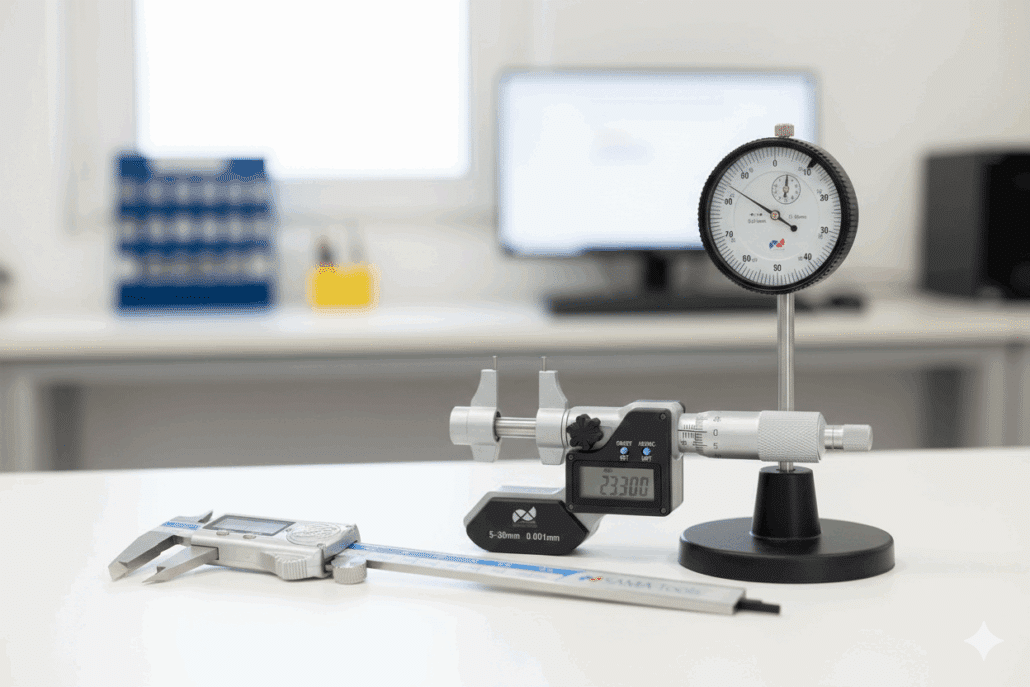
In a company’s dimensional control system, the dial gauge indicator works alongside direct measuring tools like calipers and micrometers, and reference standards such as gauge blocks, creating a coordinated set of instruments for precise measurements in machining processes.
Looking for the Right Dial Gauge for Your Dimensional Control Needs?
Contact us and we’ll help you find the ideal instrument for your specific tolerances, machining process, and working environment.