

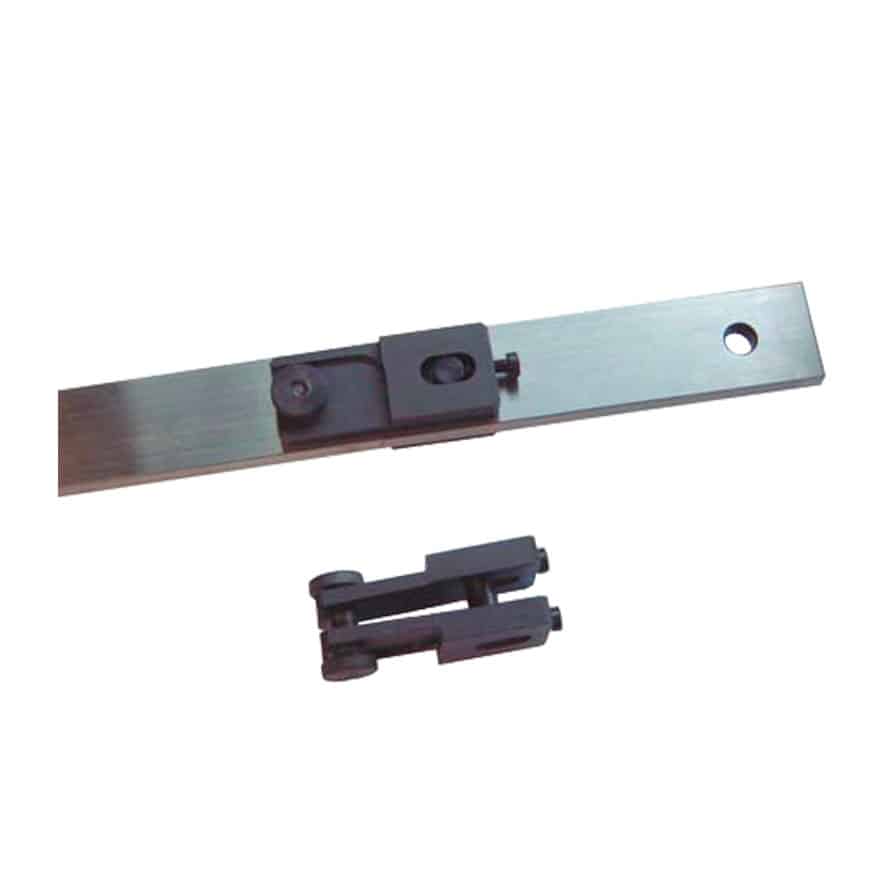
The gauge blocks connector is an accessory designed for stable assembly of long gauge blocks with mounting holes, allowing the creation of precision length standards for dimensional inspection and calibration operations.
This system is designed exclusively for long drilled gauge blocks and allows multiple elements to be connected together while maintaining a stable and reliable configuration. In this way, large reference lengths can be obtained, particularly useful when inspecting measuring instruments over extended measuring ranges.
The connector therefore represents a practical solution for metrology laboratories, quality departments and workshops requiring composable reference lengths for inspection and calibration of measuring instruments on large dimensions.
It provides robustness, stability and long-term reliability even under continuous use conditions.
Applications
- Assembly of long gauge blocks with mounting holes
- Creation of reference length standards for large dimensions
- Composition of nominal dimensions using multiple gauge blocks
- Calibration and inspection of measuring instruments on extended measuring ranges
- Use in metrology laboratories and quality control departments
FAQ – Gauge blocks connector
What is a gauge blocks connector?
It is an accessory designed to stably assemble long gauge blocks with mounting holes in order to create precision length standards for dimensional inspection and calibration of measuring instruments.
What is a gauge blocks connector used for?
It is used to connect long gauge blocks together and obtain large reference lengths for inspection and calibration of measuring instruments.
Which gauge blocks can be used with it?
It is designed exclusively for long gauge blocks with mounting holes intended for connector assembly.
Which instruments can be inspected or calibrated?
The connector is used for inspection and calibration of measuring instruments operating on extended measuring ranges.
What measuring lengths can be achieved?
By combining multiple long gauge blocks together, it is possible to create reference length standards for a wide range of measuring applications depending on the selected configuration.
Why use a gauge blocks connector instead of single gauge blocks?
The connector allows larger dimensions and more stable configurations to be obtained compared to the use of individual gauge blocks, making it particularly suitable for large dimension applications.
In which applications is it commonly used?
It is widely used in metrology laboratories, quality control departments and workshops for dimensional inspection and calibration on large nominal dimensions.
How can long reference lengths be created using gauge blocks?
To create large reference lengths, long gauge blocks with mounting holes can be assembled using a gauge blocks connector. By combining several gauge blocks together, a stable configuration is obtained for calibration and dimensional inspection applications on extended measuring ranges.
Fill out the form below to contact us.
"*" indicates required fields


