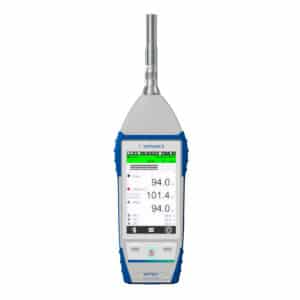
The Advanced Class 1 integrating sound level meter and spectrum analyzer is the most advanced model in the Expert line, designed for users looking for a high-level instrument for advanced acoustic measurements, environmental monitoring, building acoustics, occupational noise assessment and industrial or laboratory analysis. The XPT800 is based on a scalable platform, allowing the instrument to evolve together with application requirements without being limited to a fixed configuration.
This Class 1 sound level meter according to IEC 61672:2013 is designed to provide accuracy, versatility and ease of use. The compact and lightweight body makes field operation easier, while the 4.3” colour touch screen display improves menu navigation and data reading during long measurement sessions or complex operating activities.
From a technical point of view, one of the key features of the XPT800 is its wide dynamic range exceeding 125 dB, allowing reliable operation both in very quiet environments and in demanding acoustic conditions. The instrument supports interchangeable microphones with automatic identification through the Sensor Digital Interface and provides advanced measurement management with weightings, time constants, broadband parameters and professional-level spectral analysis.
This Class 1 spectrum analyzer performs real-time octave and one-third octave band analysis according to IEC 61260-1:2014, in addition to parallel FFT analysis. It also includes advanced acoustic criteria such as NC, NR, PNC and RC, reverberation time T60 calculation and speech intelligibility analysis STI/STIPA. These features place it in a more advanced category than a standard integrating sound level meter, making it ideal for specialist acoustic applications.
Another strong point is its data management capability. The XPT800 offers 4 GB internal eMMC memory, microSD support and the possibility of using external USB memory devices. Connectivity includes Wi-Fi, 4G, LAN, USB-C and RS232/485 interfaces, simplifying data transfer, remote control and integration into structured measurement campaigns. Data can also be archived and synchronised through NS Storage, improving the management of distributed monitoring activities and shared projects.
From an operational point of view, this advanced integrating sound level meter includes highly useful automatic functions for unattended monitoring: automatic audio recording, advanced triggers, spectral masks, automatic tonal component identification and impulsive event detection. In environmental and industrial acoustics, these functions help document events more effectively and improve technical interpretation of measured phenomena.
The internal rechargeable battery with intelligent power management supports more than 24 hours of continuous operation. This is a real advantage for long-term monitoring campaigns, environmental noise surveys and outdoor activities where autonomy and reliability are essential alongside metrological performance.
The XPT800 also supports a triaxial input for vibration sensors, currently under development, making it an open platform for even more extensive measurement applications. In summary, this is the sound level meter to choose when maximum flexibility, advanced acoustic analysis functions and top-level instrumentation are required for the most demanding applications.
Applications
- Environmental noise monitoring
- Building acoustics
- Occupational noise exposure assessment
- Industrial noise analysis
- Acoustic product testing
- Octave, one-third octave and FFT spectral analysis
- Reverberation time T60 measurement
- Advanced evaluations with triggers, audio and automatic detectors
FAQ – Advanced Class 1 integrating sound level meter and spectrum analyzer
What is the XPT800?
It is a high-end Class 1 integrating sound level meter and spectrum analyzer designed for advanced professional acoustic applications.
Which applications is it intended for?
It is intended for environmental noise, building acoustics, workplace noise, industrial analysis and acoustic product testing.
What is the difference compared to the XPT801?
The XPT800 is the more advanced model in the range, with extended analysis functions, higher dynamic range and features designed for specialist applications.
Does it support one-third octave analysis?
Yes, it performs real-time octave and one-third octave analysis according to IEC 61260-1:2014.
Can it also perform FFT and T60 analysis?
Yes, it includes real-time FFT analysis and reverberation time T60 calculation functions.
Is it suitable for unattended monitoring?
Yes, thanks to automatic audio recording, advanced triggers and automatic event identification.
How is data managed?
Data can be stored in internal memory, on microSD or external USB devices, and synchronised through NS Storage.
Is the battery suitable for long-term campaigns?
Yes, the internal rechargeable battery supports over 24 hours of continuous measurements.
Fill out the form below to contact us.
"*" indicates required fields