

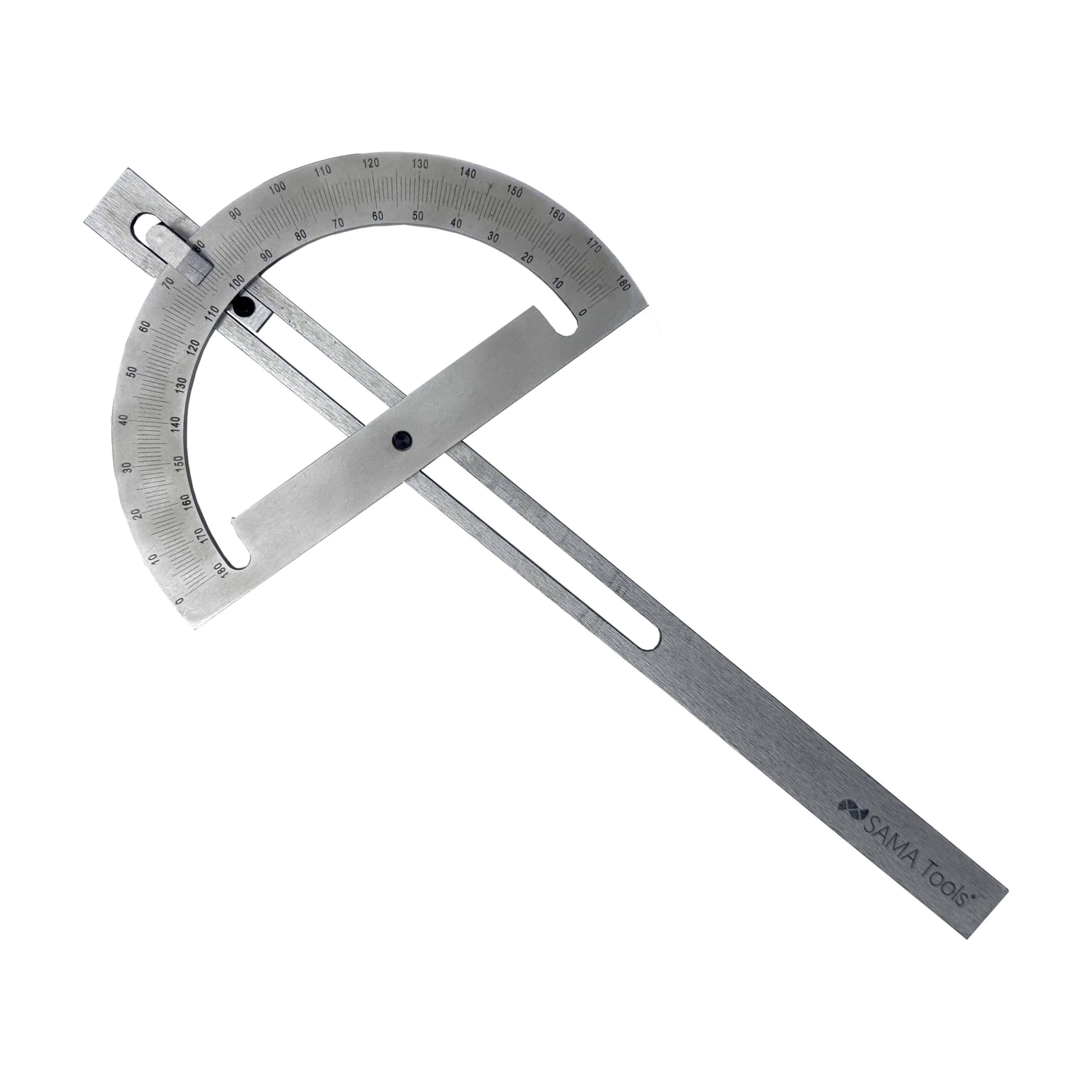
The adjustable rod protractor is an instrument designed for measuring and checking angles, inclinations and bevels when, besides reading the angle, greater flexibility in positioning the reference point is required. Compared to a simpler model, this version offers a more versatile configuration, particularly useful when inspections must adapt to components with different shapes or to surfaces that are not always easy to reach.
The distinguishing feature of this instrument is the adjustable rod, which allows the operator to vary the useful reference position according to the component being inspected. This solution is very practical when working on surfaces of different lengths, inclined profiles, components with particular obstructions or situations where the contact point does not coincide with a wide or easily accessible surface. The possibility of sliding the rod makes the inspection more flexible and more consistent with the actual geometry of the component.
From an application point of view, the adjustable rod protractor is suitable for checking internal and external angles, inclined surfaces, bevels, tooling and mechanical components during machining, assembly and setup operations. It is also useful when an existing angle must be compared with the value specified on the drawing or when an inclination has to be transferred onto a component.
Another advantage of this configuration is its versatility during workshop inspections. The adjustable rod allows the instrument to adapt to components of different dimensions without changing the inspection method. This makes the adjustable rod protractor particularly useful in mechanical workshops, tooling departments and quality control where operators often deal with non-identical components and where operational speed is important.
During setup and adjustment operations, this type of instrument helps verify quickly whether a surface, tooling element or component is positioned at the correct angle. The possibility of changing the rod position is also useful when checking less accessible areas or when the component includes steps, interruptions or non-continuous reference surfaces.
Very useful together with the adjustable rod protractor are angle gauge blocks. These blocks create known angular references and are practical both for checking the protractor and for calibration activities. In practical use, they allow comparison between the instrument reading and a defined angular value, helping verify correct instrument performance during internal inspections.
In summary, the adjustable rod protractor is a practical and technically reliable solution when a more adaptable angular measuring instrument is required for checking angles on different components with greater positioning flexibility.
Applications
- Inspection of internal and external angles on mechanical parts
- Verification of bevels, inclined surfaces and angular profiles
- Checking correct positioning during setup and tooling operations
- Inspection of tooling and components with different inclinations
- Measurement of angles on components with variable reference positions
- Workshop, tooling and quality control inspections
- Verification of angles on components with difficult-to-reach areas
- Verification and calibration of the protractor using angle gauge blocks
FAQ – Adjustable rod protractor
What is an adjustable rod protractor?
It is an instrument used for measuring and checking angles, inclinations and bevels, equipped with an adjustable rod that allows the reference position to adapt to the component.
What is an adjustable rod protractor used for?
It is used to verify angles on mechanical parts, tooling and inclined surfaces when it is useful to adjust the rod position according to the geometry of the component.
What is the advantage of the adjustable rod?
The adjustable rod makes the instrument more versatile because it allows inspections to adapt to components of different shapes and dimensions and to less accessible surfaces.
When is it more useful than a simple protractor?
It is more useful when the support point changes from one component to another, when surfaces have different geometries or when inspections must be carried out in less accessible areas.
Which inspections is this instrument most commonly used for?
It is commonly used for checking bevels, inclinations, internal and external angles, tooling, machined surfaces and angular references during machining, assembly and setup operations.
Can both internal and external angles be checked?
Yes, the adjustable rod protractor can be used for checking both internal and external angles depending on how it is positioned on the component.
Can it also be used for layout operations?
Yes, besides measurement it can also be used to transfer an angle onto the component or to set an angular reference during machining.
Where is an adjustable rod protractor most commonly used?
It is commonly used in mechanical workshops, tooling departments, quality control and in all applications where angle inspections require greater positioning flexibility.
Are angle gauge blocks useful with an adjustable rod protractor?
Yes, angle gauge blocks are very useful because they create known angular references for comparison during instrument verification.
Can angle gauge blocks also be used for checking the protractor?
Yes, they are a practical solution for verifying whether the protractor reads a specific angle correctly by comparing the reading with a defined angular reference.
Are angle gauge blocks also useful for calibration?
Yes, they are very useful for calibration because they provide precise angular references and help verify the reliability of the instrument reading.
What common mistakes should be avoided when using an adjustable rod protractor?
Common mistakes include positioning the rod without proper contact support, locking it inconsistently against the surface being checked or taking readings on dirty or burred components.
Fill out the form below to contact us.
"*" indicates required fields
| Code | Arch (mm) | Rod (mm) |
| SA5400-02 | 120 | 240 |
| SA5400-03 | 150 | 300 |
| SA5400-04 | 200 | 400 |
| SA5400-05 | 250 | 500 |
| SA5400-06 | 300 | 600 |
| SA5400-07 | 400 | 800 |
| SA5400-08 | 400 | 1000 |


