

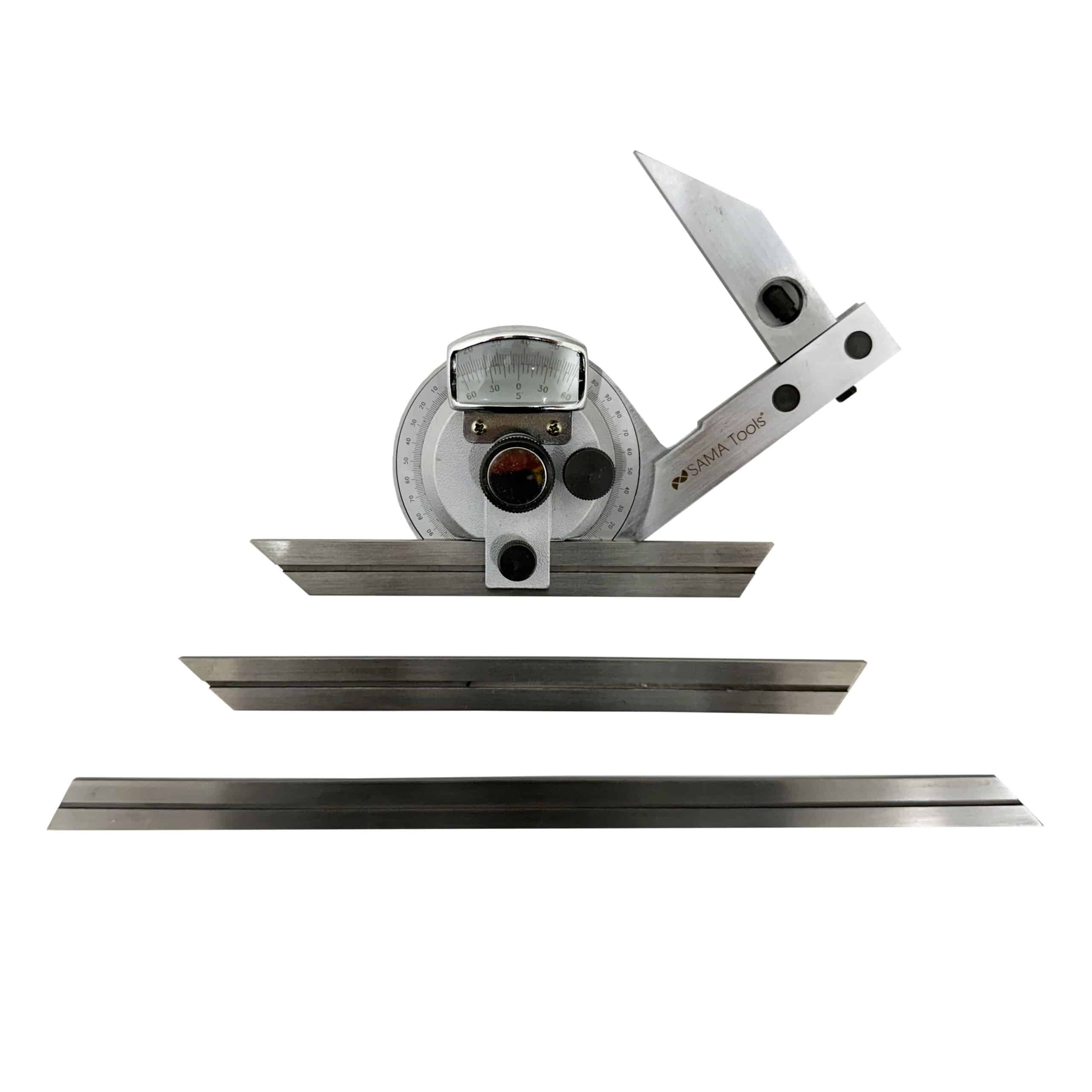
The bevel protractor with magnifying lens is a measuring instrument designed for checking and measuring angles, inclinations and bevels in mechanical applications, workshops and tooling operations. It is a practical solution when it is necessary to verify a direct angle on a component, compare an inclined profile or set an angular reference during machining or assembly.
The presence of the magnifying lens improves scale visibility, helping the operator read the angle more comfortably and accurately. This feature is especially useful during repetitive inspections, bench adjustments and in all situations where the bevel protractor is used multiple times during the same working phase.
The bevel protractor with magnifying lens is supplied with blades of 150, 200 and 300 mm, allowing the instrument to be configured according to the type of inspection to be performed. This makes the instrument highly versatile, because it can adapt both to small components and to larger surfaces or angled references. Shorter blades are useful for confined spaces and smaller parts, while longer blades provide a wider and more stable contact surface when checking larger inclinations or edges.
From an application point of view, the bevel protractor is suitable for checking internal and external angles, bevels, angular shoulders, inclined surfaces, fixtures and dimensional references. It is also useful for layout operations and angular setting during workshop activities and quality inspections.
Compared to fixed-angle gauges, this instrument offers greater versatility because it allows operators to check different angle values using the same instrument, without being limited to preset values. For this reason, it is particularly useful when working on non-standard components, tooling, fixtures and mechanical parts requiring variable angular verification.
In workshops, it is frequently used during setup and adjustment operations when the inclination of a surface or fixture must be checked quickly against the angle specified on the drawing. The possibility of selecting the most suitable blade length makes the instrument more practical and better aligned with the actual geometry of the component.
A particularly useful accessory for the bevel protractor with magnifying lens is the use of angle gauge blocks, which allow the creation of known and repeatable angular references. These are useful both for verification and calibration of the instrument, because they make it possible to compare the displayed angle with a precise angular reference. In practical applications, they are especially valuable when a reliable angular reference is required during periodic inspections or setup operations.
In summary, the bevel protractor with magnifying lens is a versatile angular measuring instrument suitable for checking and transferring angles on components of different sizes, offering improved readability and interchangeable blades for greater application flexibility.
Applications
- Inspection of internal and external angles on mechanical parts
- Verification of bevels, inclined surfaces and angular machining
- Inclination checks during setup and tooling operations
- Inspection of fixtures and components with angled profiles
- Layout and angle transfer operations on parts
- Workshop, tooling and quality control inspections
- Measurement of angles on small and large components thanks to interchangeable blades
- Verification and calibration of the bevel protractor using angle gauge blocks
FAQ – Bevel protractor with magnifying lens
What is a bevel protractor with magnifying lens?
It is a measuring instrument used for checking, measuring and transferring angles on components, surfaces and mechanical parts.
What is a bevel protractor with magnifying lens used for?
It is used to verify inclinations, internal and external angles, bevels and angled surfaces directly on the component or during machining operations.
What is the advantage of the magnifying lens?
The magnifying lens improves scale visibility and helps the operator read the angle more comfortably during inspection.
Why are different blades supplied with the instrument?
The 150, 200 and 300 mm blades allow the instrument to adapt to components of different sizes and to surfaces with different geometries.
When should the 150 mm blade be used?
It is useful for small parts, confined spaces and inspections requiring a shorter contact surface.
When are the 200 mm and 300 mm blades useful?
They are useful on larger surfaces, bigger components or more extended angular references where a wider support surface is beneficial.
Can internal and external angles both be checked?
Yes, the bevel protractor with magnifying lens is suitable for checking both internal and external angles depending on blade positioning.
Which inspections is this instrument most commonly used for?
It is frequently used for checking bevels, inclinations, angular shoulders, tooling, machined surfaces and angular references during setup and assembly operations.
Can it also be used for layout operations?
Yes, besides measurement, it can also be used to transfer an angle onto a component or to set an angular reference during machining.
Are angle gauge blocks useful with this bevel protractor?
Yes, angle gauge blocks are very useful because they allow the creation of known angular references for instrument comparison and verification.
Can angle gauge blocks also be used for calibration?
Yes, they are particularly useful for calibration because they provide precise and repeatable angular references for checking the instrument reading.
Where is this bevel protractor most commonly used?
It is commonly used in mechanical workshops, tooling departments and quality control applications where variable angles must be checked quickly and accurately.
What does this instrument check in practical use?
It checks the angular value between two sides, two surfaces or between a reference plane and an inclined surface.
What common mistakes should be avoided when using a bevel protractor with magnifying lens?
Common mistakes include incorrect positioning on the component, reading the scale without proper visual alignment or using a blade not suitable for the actual size of the surface being checked.
Fill out the form below to contact us.
"*" indicates required fields
| Product code | Rod (mm) |
| SA4980 | 150-300 |


