

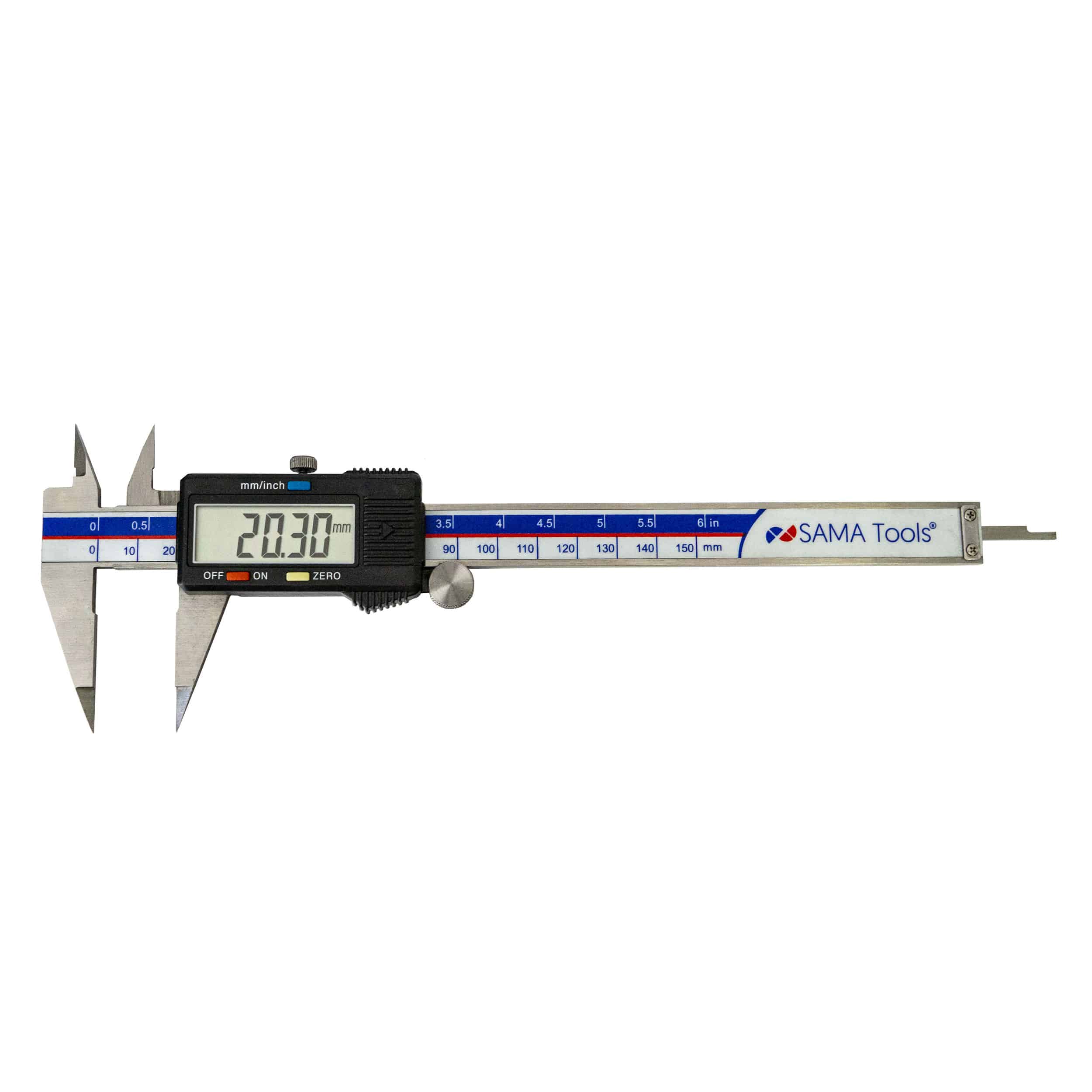
The pointed-jaw digital calipers is a measuring instrument designed for workshop and quality control applications where it is necessary to measure dimensions on geometries that are difficult to reach with standard jaws.
Equipped with narrow pointed jaws, it allows measurements on components with restricted access. The jaw shape improves contact in narrow areas where traditional calipers are limited.
Manufactured in stainless steel, it guarantees robustness and long-term stability even in continuous use. The LCD display provides a clear and immediate reading of values.
The 0.01 mm resolution and mm/inch conversion allow fast and accurate measurements, improving dimensional inspection reliability even on complex components.
Thanks to the pointed jaw configuration, this caliper is particularly suitable for inspections on components with narrow or difficult-to-access geometries, where more precise contact than standard jaws is required.
Applications
- Geometries with restricted access and narrow seats
- Inspection of diameters in difficult areas
- Dimensional inspections on complex components
- Quality control in workshop and production
FAQ – Pointed-jaw digital calipers
When should a pointed-jaw caliper be chosen?
When the dimension to be checked is located in narrow or restricted-access areas where standard jaws cannot reach correctly.
What are pointed jaws used for on a digital caliper?
They improve contact on difficult-to-reach measuring points, making it possible to inspect dimensions that would be impossible to verify with a traditional caliper.
On which components is it most commonly used?
It is mainly used on components with narrow seats, grooves, restricted spaces and in general on geometries where the measuring point is not easily accessible.
What is the advantage compared to a caliper with standard jaws?
It allows access to tighter areas and measurements on points where a traditional jaw profile would be too bulky.
Is it suitable only for special applications or also for daily use?
It is particularly useful for specific applications, but it can also be used daily when components with difficult geometries are frequently inspected in production.
In which industrial contexts is it most commonly used?
It is commonly used in mechanical workshops, quality control and production, where dimensions on complex or difficult-to-reach components must be verified.
For which dimensional inspections is it most commonly selected?
For inspections on diameters and localized dimensions in narrow areas, especially on mechanical parts where accessibility is the main issue.
Can it help reduce measurement errors on narrow geometries?
Yes, because the jaw shape allows more suitable contact in restricted areas, making the inspection more consistent with the component geometry.
Why choose a dedicated pointed-jaw caliper instead of adapting a standard one?
Because in these applications jaw geometry is critical and a dedicated instrument allows measurements to be performed more correctly and quickly.
Is it a good choice for quality control?
Yes, especially when the quality department must inspect components with restricted access and requires a dedicated instrument for that type of inspection.
Fill out the form below to contact us.
"*" indicates required fields


