The between-centers inspection bench is a solution designed for the dimensional and geometrical inspection of shafts and cylindrical components, particularly useful when concentricity and rotational accuracy must be checked continuously during rotation. It is intended for workshops, quality control departments and metrology rooms where cylindrical components need to be inspected in a practical, stable and repeatable way.
The operating principle is simple and effective: the component is positioned between two centres and checked during rotation using a dial gauge. This makes it possible to detect geometrical deviations directly and evaluate the behaviour of the component relative to its own axis.
The bench is equipped with two tailstocks, one fixed and one movable with positioning handwheel. This configuration makes component positioning easier and allows the bench to be adapted to parts of different lengths. The locking knob on the movable tailstock helps secure the component in a stable position during inspection, an important feature for maintaining consistency and repeatability of measurement.
The dial gauge is supplied as standard and mounted on its dedicated support. The dial gauge holder can be moved horizontally by means of a handwheel, allowing the operator to travel along the component and inspect several points along its length without manually repositioning the measuring system. This represents a practical advantage when checking shafts and cylindrical parts, especially on long components or where multiple inspection points are required.
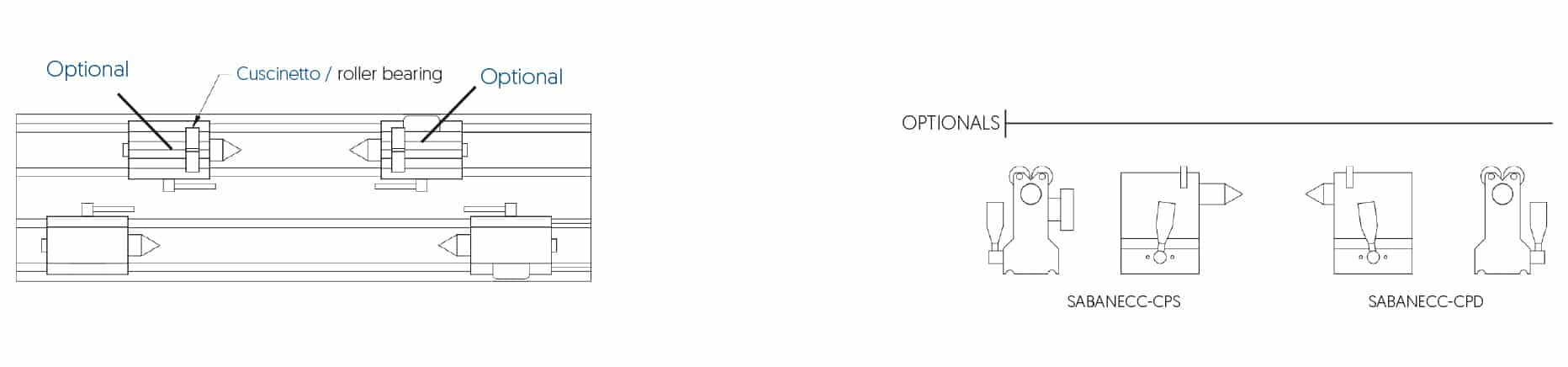
The bench is also equipped with support rollers for shafts without centre holes, significantly expanding the application possibilities. In addition to components prepared for traditional between-centres inspection, it is also possible to check components without centre holes, making the system more versatile for real workshop and testing applications.
The structure of the bench is designed to provide a stable reference and good ease of use during repetitive inspections. When checking ground shafts, pins and machined cylindrical components, system stability is essential in order to obtain consistent measurements and reliably compare different parts from the same production batch.
Another strength of this bench is that it goes beyond simply supporting the component, allowing true geometrical inspection during rotation. For this reason it is particularly useful when concentricity, runout and general rotational behaviour must be verified under conditions close to the real operating axis of the component.
An optional support accessory is also available to further expand the application range of the bench depending on the type of component being inspected. For companies working with shafts, rollers, pins and other cylindrical components, this bench represents a practical and professional solution for making quality control faster, more organised and more repeatable.
Applications
- Inspection of ground shafts and cylindrical components
- Concentricity verification
- Geometrical inspection of components machined between centres
- Inspection of shafts without centre holes using support rollers
- Quality control in workshops, production and metrology rooms
FAQ – Between-centers Inspection Bench
What is a between-centers inspection bench used for?
It is used to inspect shafts and cylindrical components by evaluating their behaviour during rotation, particularly for concentricity and geometrical checks.
When should a between-centers inspection bench be preferred over a simpler solution?
It is recommended when the component must be checked more consistently relative to its axis and where more reliable geometrical inspection is required on cylindrical parts.
What is the advantage of having one fixed and one movable tailstock?
It allows easier positioning and locking of the component while adapting the bench to parts of different lengths.
What is the purpose of the handwheel on the movable tailstock?
It is used to bring the tailstock into contact with the component, simplifying correct positioning before locking.
Why is the horizontally adjustable dial gauge holder a practical advantage?
It allows the dial gauge to travel along the component and inspect multiple points more quickly without manually repositioning the measuring system.
Is the dial gauge included?
Yes, the dial gauge is supplied as standard, so the bench is ready for basic inspection work.
Can it be used only on components machined between centres?
No, thanks to the support rollers it can also be used for shafts without centre holes, expanding the range of applications in workshops and testing departments.
Which inspections are most commonly carried out with this bench?
Mainly concentricity checks and geometrical inspections on shafts, pins and cylindrical components.
Why is it useful for ground shafts?
Because this type of component often requires rotational accuracy checks and verification of geometrical deviations along the surface.
Is it suitable for repetitive production inspections?
Yes, because it provides a stable configuration, is practical to use and suitable for frequent inspection of production batches.
In which departments is it most commonly used?
It is widely used in machine shops, quality control departments, testing areas and metrology rooms where cylindrical components must be checked consistently.
Why choose a between-centers inspection bench?
Because it allows more accurate geometrical inspection on cylindrical components using a stable and more reliable setup than simpler support systems.
Fill out the form below to contact us.
"*" indicates required fields
| Code | Range (mm) | B (mm) | C (mm) | Diam.Max (mm) |
| SABANECC-300C | 300 | 540 | 75 | 150 |
| SABANECC-500C | 500 | 740 | ||
| SABANECC-300150C | 230 | 540 | 150 | 300 |
| SABANECC-500150C | 430 | 740 |