

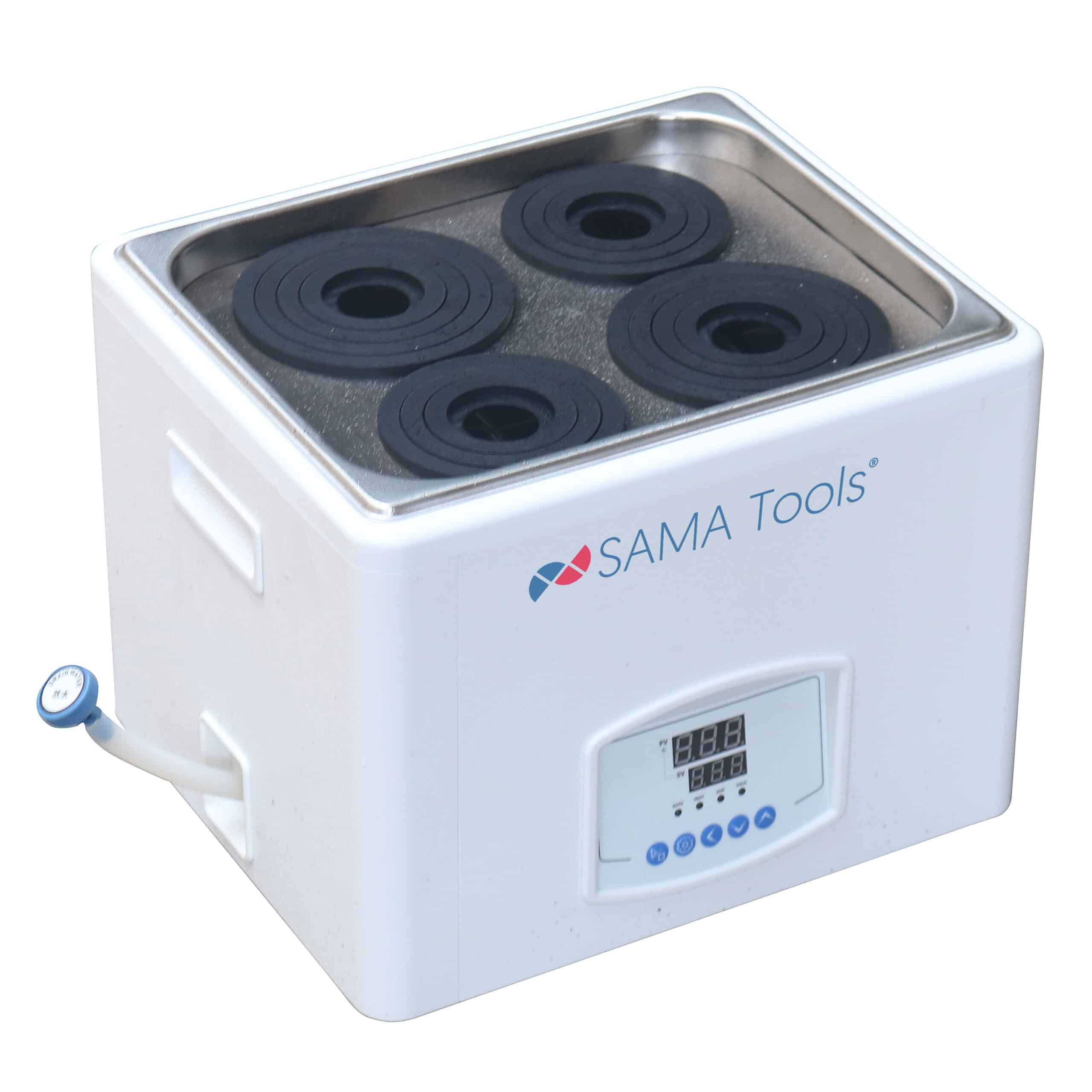
The thermostatic water baths are laboratory instruments used to heat samples and maintain a uniform temperature during water-bath heating. They are suitable when a sample must be brought to and maintained at a controlled temperature, avoiding direct contact with a heat source.
A thermostatic water bath provides more even heat distribution than direct heating because the sample is immersed or kept inside containers heated by the water in the bath. This method is useful in chemical laboratories, quality control, research, sample preparation and tests where stable thermal conditions are important.
The range includes several models with different capacities, allowing the most suitable instrument to be selected according to sample volume and the number of containers to be treated. Available versions also feature different numbers of lid openings, making it possible to work with several samples at the same time according to laboratory organisation.
The working range extends from ambient temperature +5 °C to +99 °C, with a temperature stability of ±0.5 °C. This helps keep samples under controlled conditions for the selected time, reducing unwanted temperature variations during water-bath treatment.
The integrated timer allows heating or holding time to be managed when the treatment requires a defined duration. This makes the thermostatic water bath suitable both for straightforward preparation work and for repetitive laboratory activities.
The laboratory water baths are suitable for many applications, including liquid heating, thermal conditioning of samples, temperature-controlled holding, test preparation and laboratory activities requiring a stable, uniform temperature.
Model selection depends mainly on the required capacity, the number of samples to be treated, the type of container used and the required working temperature. More compact models are suitable for a limited number of samples, while higher-capacity versions are intended for laboratories that need to manage more containers or larger volumes.
Applications
- Water-bath heating of samples
- Maintaining a uniform sample temperature
- Test preparation in chemical and quality-control laboratories
- Thermal conditioning of compatible liquids and materials
- Use in research laboratories, schools, universities and technical departments
- Simultaneous handling of several samples according to the number of available openings
- Temperature-controlled treatments up to 99 °C
- Laboratory procedures requiring thermal stability and a defined treatment time
FAQ – Thermostatic water baths
What is a thermostatic water bath used for?
It is used to heat samples and maintain a uniform temperature during water-bath treatment. It is useful when the sample must be processed at a controlled temperature without direct heating.
What is the difference between a thermostatic bath and a laboratory water bath?
In practical use, these terms often refer to similar instruments. A thermostatic bath is a laboratory water bath equipped with temperature control to maintain stable thermal conditions.
What is the temperature range of SAWB thermostatic water baths?
The working range extends from ambient temperature +5 °C to +99 °C. This allows heating and temperature-controlled holding within a range suitable for many laboratory activities.
Does the temperature remain stable during use?
Yes. Temperature stability is ±0.5 °C, helping to keep samples under controlled conditions throughout the treatment.
Are models with different capacities available?
Yes. Several models with different capacities are available. Selection depends on sample volume, the number of containers to be treated and the required internal space.
What are the openings in the lid used for?
They allow containers to be inserted or kept in position during water-bath heating. The number of openings depends on the selected model.
Does the thermostatic water bath have a timer?
Yes. The timer allows the treatment or holding time to be set when the laboratory procedure requires a defined duration.
Which laboratories use thermostatic water baths?
They are used in chemical laboratories, quality-control departments, research centres, schools, universities and technical departments where samples must be heated or maintained at a controlled temperature.
Fill out the form below to contact us.
"*" indicates required fields


