

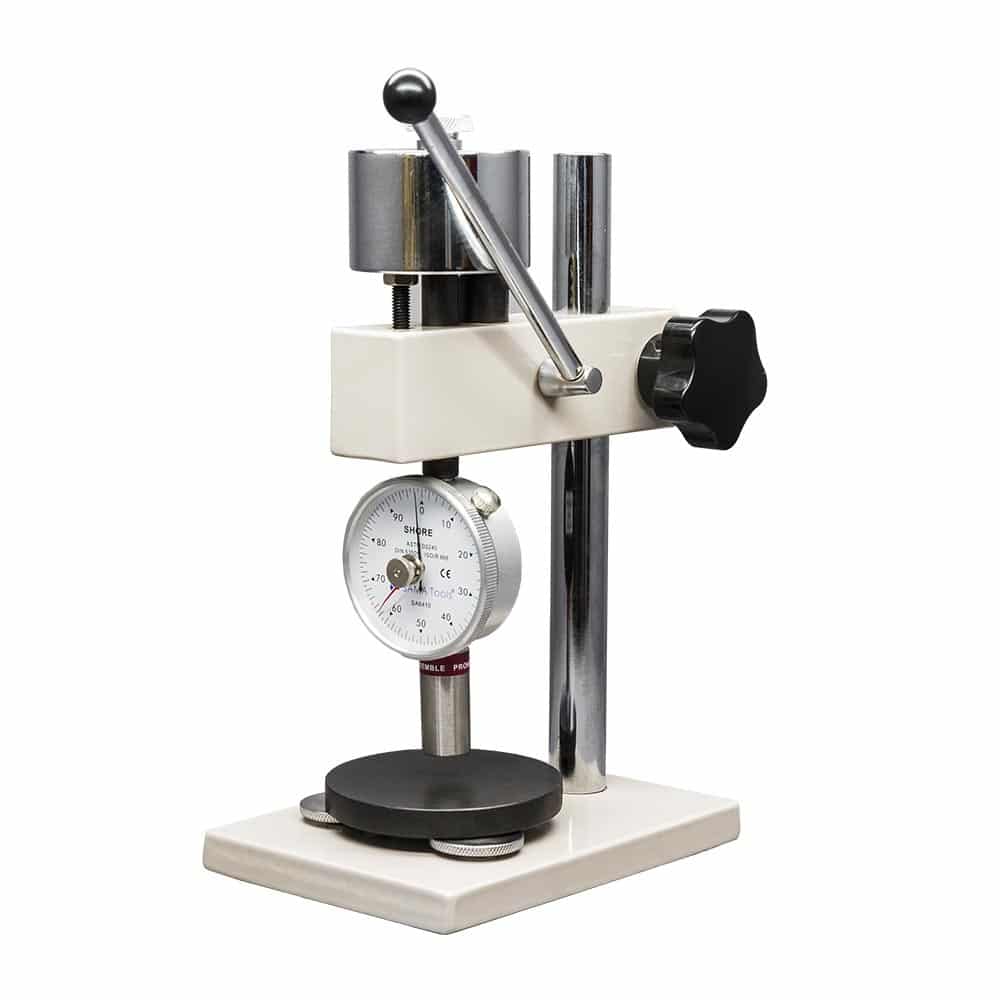
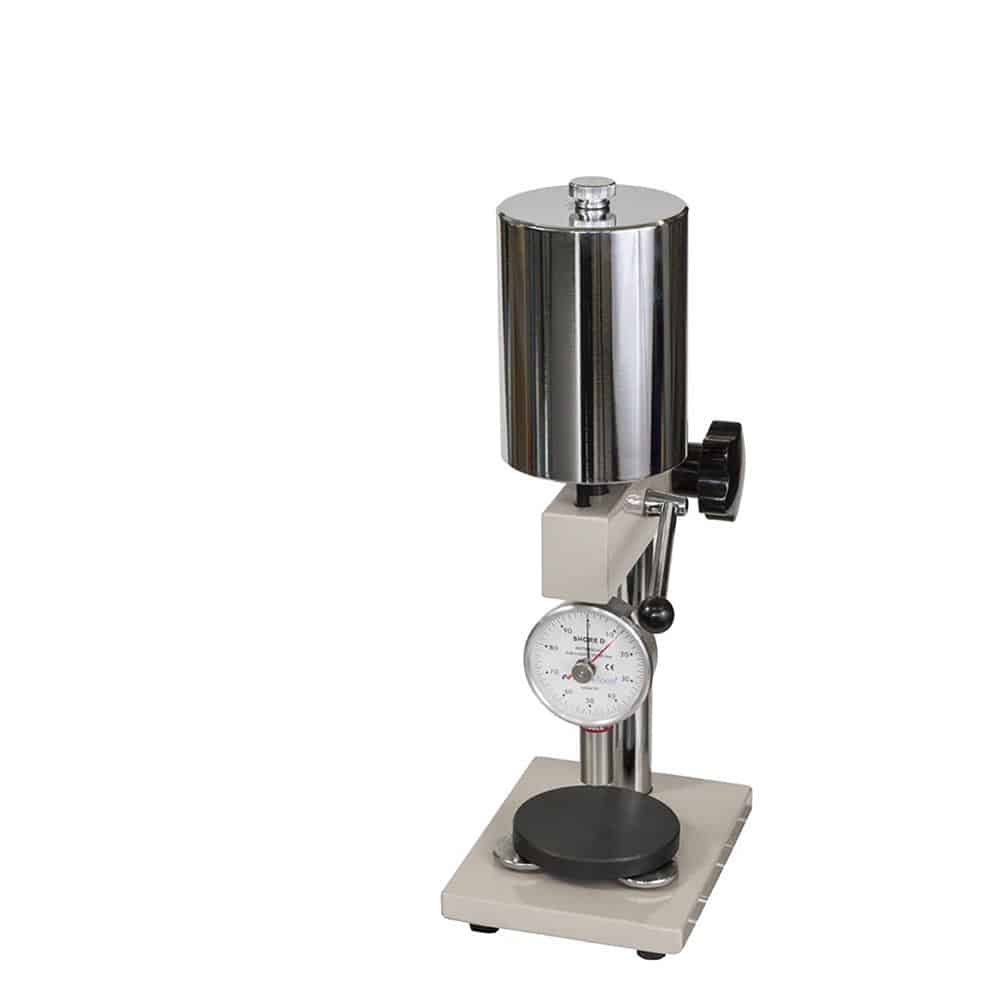
The analog Shore hardness tester test stands are bench supports designed for using dial-type Shore hardness testers under more stable, controlled and repeatable test conditions. They are not standalone measuring instruments, but accessories that allow the hardness tester to be installed, guide its movement and apply the load to the sample more uniformly than with manual use.
In Shore hardness measurement, the result can be affected by the way the operator positions the instrument, its perpendicularity to the surface, sample stability and the force applied during contact. The stand reduces these variables and makes the test more comparable from one measurement to the next.
The main advantage is the possibility of applying a more consistent pressing force to the sample. Thanks to the guided structure and dedicated load weight, the hardness tester is applied more regularly, reducing operator influence and improving the repeatability of the Shore test.
The stands are suitable for mounting SA6410 analog Shore hardness testers, dial instruments used for checks on rubber, elastomers, soft PVC, rigid plastics and similar materials, according to the Shore scale used.
The range includes two main versions. The SAMTS6410-AE stand is intended for analog Shore hardness testers in Shore A scale, therefore for rubber and elastic or deformable materials compatible with this scale. The SAMTS6410-D stand is instead designed for analog Shore hardness testers in Shore D scale, used for harder materials with greater resistance to penetration.
The difference between the two versions concerns the load configuration and its adaptation to the Shore scale of the installed hardness tester. This allows the support to operate consistently with the type of test to be performed, avoiding the use of the same configuration for scales that require different operating conditions.
Using the stand is particularly useful when measurements are repeated, when different samples need to be compared or when checks are carried out in production, laboratories or incoming inspection. In these situations, manual application alone can introduce operating differences that make results less comparable.
The stand structure keeps the hardness tester in a vertical position relative to the sample surface. This helps prevent inclination during the test and promotes more correct contact between the indenter and the material.
The platform allows the sample to be positioned stably during measurement. Adjustable feet help improve base positioning, contributing to correct sample alignment in relation to the hardness tester.
For small, soft or easily deformable samples, the stand offers an important practical advantage because it allows the contact phase to be controlled more effectively. The test becomes more orderly and less dependent on the operator’s handling.
When the sample has insufficient thickness, multiple samples made from the same material can be stacked to reach the thickness appropriate for the measuring scale, provided that the assembly remains stable, uniform and representative of the check to be performed.
Optional Shore A/D hardness test blocks can be used for internal checks of hardness tester response. When used with the stand, they allow periodic checks to be carried out with a more uniform application method than manual testing.
Compared with using the analog Shore hardness tester alone, the stand makes measurement more repeatable and more suitable for systematic checks. It is a suitable solution for users who regularly use dial-type hardness testers and want to improve stability, applied pressure and comparison of results.
Applications
- Bench use of analog Shore hardness testers
- Checks with analog Shore A hardness testers
- Checks with analog Shore D hardness testers
- Repeated measurements on rubber and elastomers
- Checks on soft PVC and flexible materials
- Checks on rigid plastics compatible with Shore D
- More consistent application of pressing force
- Improved perpendicularity during testing
- Reduction of operator influence
- Comparative tests on samples from hardness testers
- Checks with analog Shore A hardness testers
- Checks with analog Shore D hardness testers
- Repeated measurements on rubber and elastomers
- Checks on soft PVC and flexible materials
- Checks on rigid plastics the same batch
- Quality-control checks in production
- Laboratory and incoming-inspection checks
- Tests on prepared samples and representative specimens
- Support for Shore tests carried out using a repeatable method
FAQ – Shore analog hardness tester test stands
What are analog Shore hardness tester test stands used for?
They are used to operate dial-type Shore hardness testers more stably and repeatably, keeping the instrument perpendicular to the surface and applying the load more uniformly than during manual use.
Do the stands measure Shore hardness?
No. The stand does not measure hardness. Measurement is performed by the analog Shore hardness tester mounted on the support.
Why use a stand instead of a manual hardness tester?
The stand reduces operator influence, improves test stability and allows a more consistent pressing force to be applied to the sample.
Does the stand improve measurement repeatability?
Yes. By guiding the movement of the hardness tester and maintaining more consistent contact with the sample, the stand helps achieve more repeatable results during Shore checks.
What does more consistent pressure mean?
It means that the hardness tester is applied to the sample through a guided structure and a dedicated load weight, reducing the variations typical of manually performed tests.
Which hardness testers are these stands compatible with?
They are suitable for mounting SA6410 analog Shore hardness testers, selecting the correct version according to the Shore scale used.
Which stand is used for Shore A?
The SAMTS6410-AE version is used with analog Shore hardness testers in Shore A scale.
Which stand is used for Shore D?
The SAMTS6410-D version is used with analog Shore hardness testers in Shore D scale.
Why are there two different stand versions?
Different Shore scales require different load conditions. The stand version must therefore be consistent with the scale of the installed hardness tester.
When is it advisable to use the stand?
It is advisable when repeated measurements, checks on several samples, comparative evaluations or tests requiring reduced operator-related variability are carried out.
Is the stand useful in production checks?
Yes. In production quality-control checks, the stand helps make the test method more uniform and facilitates comparison between samples or different batches.
Does the sample need special preparation?
The sample must have a suitable, stable and sufficiently flat surface, with thickness appropriate for the Shore scale used.
Can multiple samples be stacked if the sample is too thin?
Yes. When the thickness of a single sample is insufficient, multiple samples made from the same material can be stacked to reach the required thickness, provided that the assembly remains stable, uniform and representative of the test.
Why is it important to keep the hardness tester perpendicular?
Because instrument inclination can alter the way the indenter enters the material, making the measurement less comparable.
What is the stand platform used for?
The platform supports the sample stably during the test, promoting more correct contact with the hardness tester indenter.
Can Shore A/D test blocks be used with the stand?
Yes. Optional Shore A/D test blocks can be used for internal checks of hardness tester response, with a more uniform application method than manual use.
Fill out the form below to contact us.
"*" indicates required fields


